Content SEO Writer: What the Job Is, What It Costs and How to Hire One
What a content SEO writer does, what Google rewards, current rates ($15 to $35 an hour on Upwork), how to hire one and where AI writing fits in.

A content SEO writer (also called an SEO content writer) researches what people search for and writes the pages that answer it: blog posts, guides, service pages and product descriptions that rank in Google and still read well. The job sits between a writer and an SEO specialist. Below you'll find what the work involves step by step, what good looks like by Google's own standards, current rates, how to hire one and where AI fits in.
TL;DR
- An SEO content writer turns a search query into a page that answers it better than the pages ranking today, then optimizes the title, headings, meta description, links and images.
- Google does not reward word counts or keyword repetition. It asks whether content is made for people and shows first-hand expertise.
- Upwork lists typical rates of $15 (beginner), $25 (intermediate) and $35 (advanced) per hour. A full-time SEO writer averages $55,299 a year according to Glassdoor data cited by Upwork.
- You can hire in-house, a freelancer or an agency, or use an AI writer that does the research. Each fits a different volume and budget.
- AI is allowed in Google Search if a person checks facts and the pages add value. Mass-produced pages without value fall under Google's spam policy on scaled content abuse.
What is an SEO content writer?
An SEO content writer creates web content that is meant to be found through search engines and to help the people who find it. CareerExplorer describes the role as writing "blog posts, articles, website pages, and other online content with the goal of improving a site's search ranking," which includes "using keywords in the right way, writing clear headings, and making sure the content is helpful and easy for people to read."
The difference to a general content writer is the starting point. A content writer usually starts from a topic, a brand message or a brief from marketing. An SEO content writer starts from a search query and asks three questions before writing a word: what does the searcher want, what do the pages that rank today already cover, and what is missing from all of them?
| Content writer | SEO content writer | Copywriter | |
|---|---|---|---|
| Starts from | A topic or brand message | A search query and its results | An offer and a target action |
| Main goal | Inform or engage readers | Rank and answer the query fully | Get the click, sign-up or sale |
| Typical output | Articles, newsletters, social posts | Blog posts, guides, landing and product pages | Ads, sales pages, emails |
| Measured by | Engagement, reach | Rankings, organic traffic, conversions | Conversion rate |
The roles overlap a lot in practice. Upwork's list of common job posts includes an "SEO blog writer," an "E-commerce SEO copywriter" and an "SEO content specialist for a PR agency," which shows how loosely companies use the titles. If you want the craft itself rather than the job, our pillar guide on writing SEO content walks through it from keyword to published page, and what SEO writing is covers the definition in more depth.
What an SEO content writer does, step by step
Job descriptions list the same core duties again and again. CareerExplorer names research, content creation, SEO optimization, editing and proofreading, analytics and improvement, and collaboration. Upwork's version adds keyword research, meta titles and descriptions, and updating existing content. In order, a typical article goes through six steps.
- Keyword research. Find the terms people search for, with volume and competition in mind. Upwork describes it as identifying "relevant words and phrases that prospective customers are searching for, while taking factors such as search volume and competition into account."
- SERP and competitor analysis. Read the pages that rank for the query. They show the intent (a definition, a how-to, a comparison, a product) and the bar the new page has to clear.
- Brief and outline. Decide the angle, the sections, the questions to answer and the sources to cite. A good outline already contains what the ranking pages leave out.
- Writing. Answer the query early, then go deeper. Keywords go where they read naturally: the title, the first paragraph, a few headings.
- On-page optimization. Write the title and meta description, link to related pages on the same site, add images with descriptive alt text. Google's SEO Starter Guide says a good title "is unique to the page, clear and concise, and accurately describes the contents of the page."
- Measure and update. Check rankings and traffic, then revise pages that slip. CareerExplorer says SEO writers "monitor website traffic and engagement metrics to see how content performs" and use that data "to update and improve existing content."
Steps 1 to 3 are where most of the time goes, and where an AI agent saves the most. Citapult's keyword research reads your site and your competitors, adds volume and difficulty, and plans 30 days ahead with one article per search intent. The writing step then starts from a brief instead of a blank page.
Types of SEO writers
CareerExplorer lists six specializations. They matter when you hire, because a strong blog writer is not automatically good at product pages.
| Type | What they write |
|---|---|
| Blog SEO writer | Blog posts built around keywords and readability |
| Website content SEO writer | Homepages, service pages, product descriptions |
| Technical SEO writer | Meta tags, structured data, content that supports technical SEO |
| Product SEO writer | Product descriptions and e-commerce content |
| Copywriting SEO writer | Promotional content that has to rank and convert |
| Local SEO writer | Location pages and content for local search and Google Maps |
What separates a good SEO content writer from a keyword stuffer
The old picture of SEO writing (a keyword repeated in every paragraph, padded to a fixed length because "long content ranks") is exactly what Google tells site owners not to do. Its guide to helpful content lists warning signs of "search engine-first content."
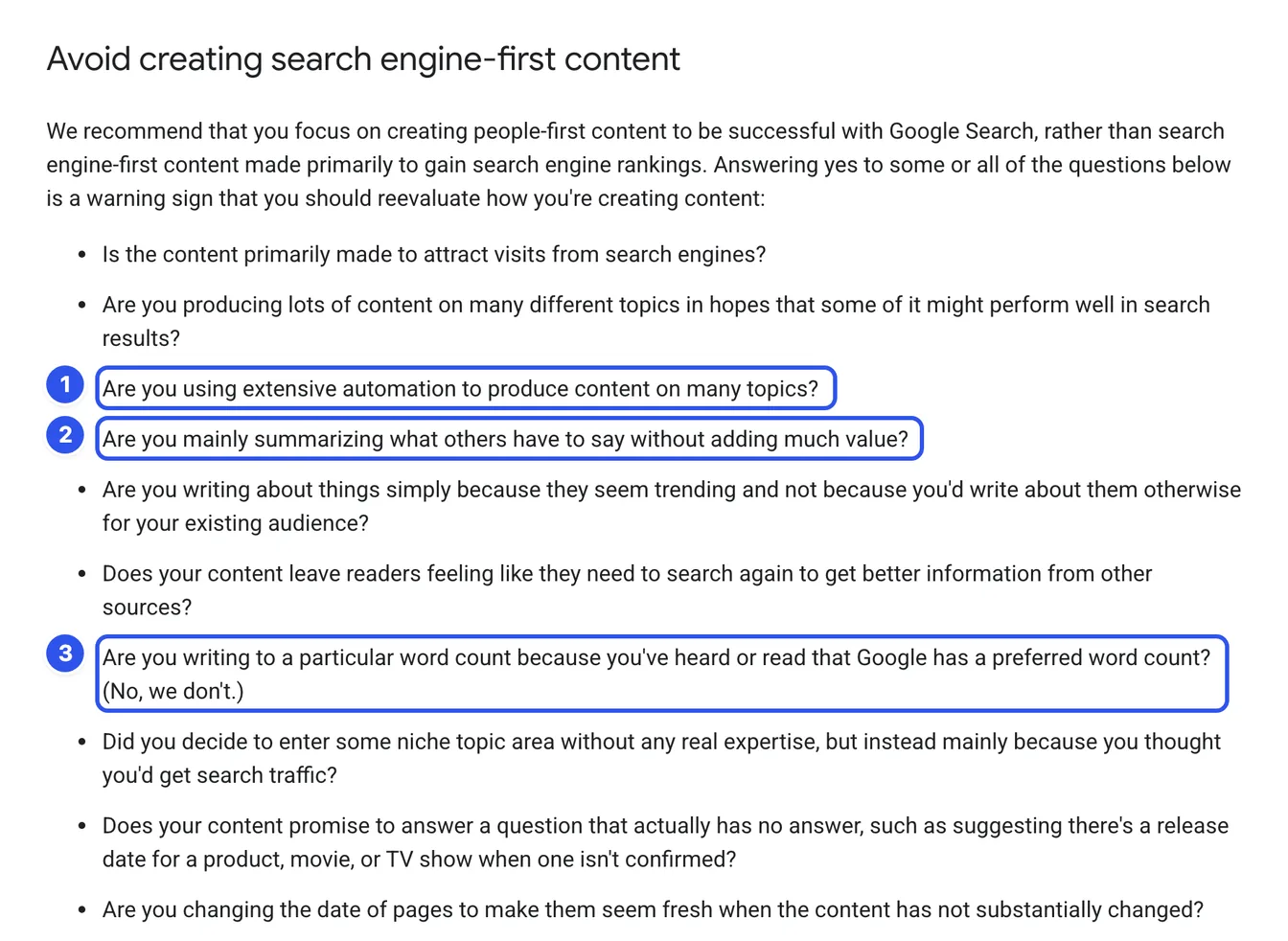
- "Are you using extensive automation to produce content on many topics?" Volume alone is a warning sign, whether a person or a tool produces it.
- "Are you mainly summarizing what others have to say without adding much value?" A rewrite of the top three results adds nothing a searcher could not already find.
- "Are you writing to a particular word count because you've heard or read that Google has a preferred word count? (No, we don't.)" Length should follow the topic, not a target.
The same guide asks whether content "clearly demonstrate[s] first-hand expertise and a depth of knowledge," for example from having actually used a product or visited a place. Google's SEO Starter Guide is just as direct about keywords: "Excessively repeating the same words over and over (even in variations) is tiring for users, and keyword stuffing is against Google's spam policies." It also notes that "Google Search doesn't use the keywords meta tag."
So a good SEO content writer can be recognized by what is in their samples:
- The answer comes first. The first paragraph answers the query; details follow.
- Something original. A number, a test, a quote from an expert or the client's own experience that the ranking pages don't have.
- Sources you can check. Facts link to where they come from, ideally the original source rather than another blog.
- Structure for skimmers. HawkSEM's advice for SEO content: break it up "using bullet points, paragraphs, and subheadings."
- Clean metadata. Titles and descriptions that describe the page instead of repeating the keyword.
HawkSEM adds a few skills beyond writing: communication with editors and interviewees, organization across several pieces at once, a basic understanding of HTML and familiarity with content management systems like WordPress or Shopify.
How much SEO content writers cost
Rates vary by experience, niche and location, and few sources publish current figures. These are the ones we could verify.
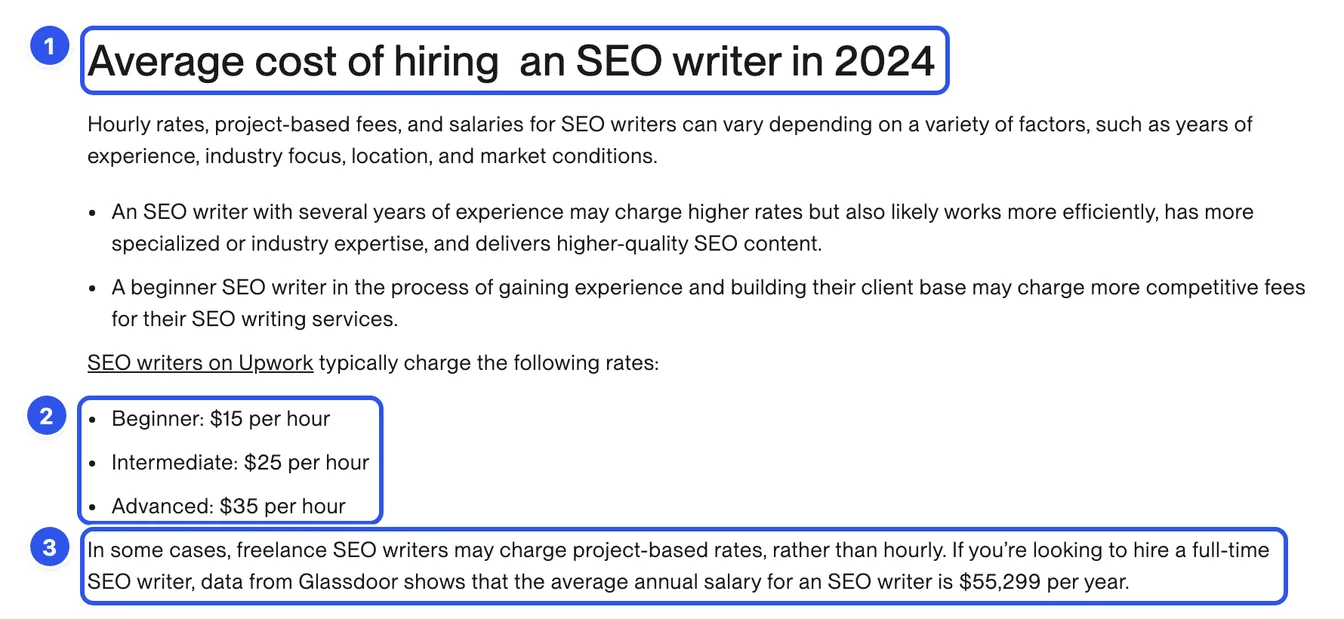
- The heading dates the figures: they describe 2024, not today.
- Typical rates on Upwork: $15 per hour for beginners, $25 for intermediate and $35 for advanced SEO writers.
- For a full-time hire, Upwork cites Glassdoor data with an average salary of $55,299 per year for an SEO writer.
For a newer number, Indeed's salary page for content writers in the United States shows an average of $23.97 per hour, with a low of $12.71 and a high of $45.22. It is based on 5k salaries from job postings in the past 36 months and was updated November 8, 2026. It covers content writers in general; Indeed does not publish a separate figure for SEO content writers. Upwork also notes that some freelancers charge per project instead of per hour, so ask for a price per article and what it includes.
| Option | Typical cost | Best for | Watch out for |
|---|---|---|---|
| In-house writer | $55,299 a year on average (Glassdoor via Upwork) | Steady volume, deep product knowledge, close work with the team | Salary is fixed whether you publish a few articles or many |
| Freelancer | $15 to $35 per hour on Upwork, or a fixed price per article | Specialist topics, flexible volume | Quality varies widely; vetting takes time |
| Agency | Project fee or monthly retainer | Strategy, writing and links in one contract | Less control over who writes your articles |
| AI writing agent | Citapult Pro: $99 a month per website for 30 articles ($3.30 each) | Many articles a month across a keyword plan | Needs your expertise and a review before publishing |
The last row is our own product, so judge it on its merits. Citapult's Pro plan costs $99 per website per month (a launch price; the regular price is $199) and includes 30 articles in your main language, images, publishing to WordPress, Webflow, Next.js or a webhook, and Search Console data for revising articles that slip. With add-ons it writes 60 articles for $184 or 90 for $259 a month. A writer with real expertise in your niche will still beat it on the topics where that expertise is the whole point.
How to hire an SEO content writer
HawkSEM sums up the choice as three options: hire in-house, hire a freelancer or hire a digital marketing agency. Whichever you pick, hiring a content writer for SEO follows the same five steps.
1. Write a clear job post. Upwork recommends four parts: a project description (content type, audience, deliverables), the project length with milestones, the background you prefer (industries, writing styles, certifications) and the budget, including whether it is hourly or fixed-price.
2. Ask for published samples. Upwork's list of requirements includes "a portfolio of published work." Look for samples in your content type: a strong blog writer may never have written a product page. Then search the sample's keyword in Google and see where it ranks.
3. Ask how they work. HawkSEM suggests interview questions such as:
- How do you typically conduct keyword research?
- How do you measure and define success in SEO?
- How do you keep up with search engine algorithm changes?
- How do you ensure your content is relevant and engaging for the reader?
A good answer to the first one mentions reading the current results, not only a keyword tool.
4. Run a paid test article. One real keyword from your plan, your brief, your style guide. You learn more from one paid article than from three interviews: how they handle sources, whether they ask questions, how much editing the draft needs.
5. Agree on the deliverable. Spell out what "done" means: the article, a title and meta description, suggested internal links, image ideas or images, sources, and who uploads it to your CMS. Upwork's requirements mention familiarity with WordPress and Webflow, which matters if the writer is to publish directly.
If you would rather buy finished articles than manage a writer, our roundup of SEO content writing services compares the options. And if you are on the other side of the table, the guide on how to become an SEO content writer covers building a portfolio and finding clients.
Can AI replace an SEO content writer?
Writers keep asking this. A thread on r/content_marketing in which an SEO content writer says they are anxious about AI, posted about four years ago, is still one of the top results for "content seo writer." The replies split into two camps, and both turned out partly right. One commenter predicted that "AI-writing is going to kill the mediocre middle, but people will always pay a premium for good content." Another found ChatGPT's output "about as good as any $.05/word writer on Upwork." A third used it for "surface-level research" and then dug deeper "to a) validate its findings, and b) find even more info."
Google's position is clear and not hostile to AI.
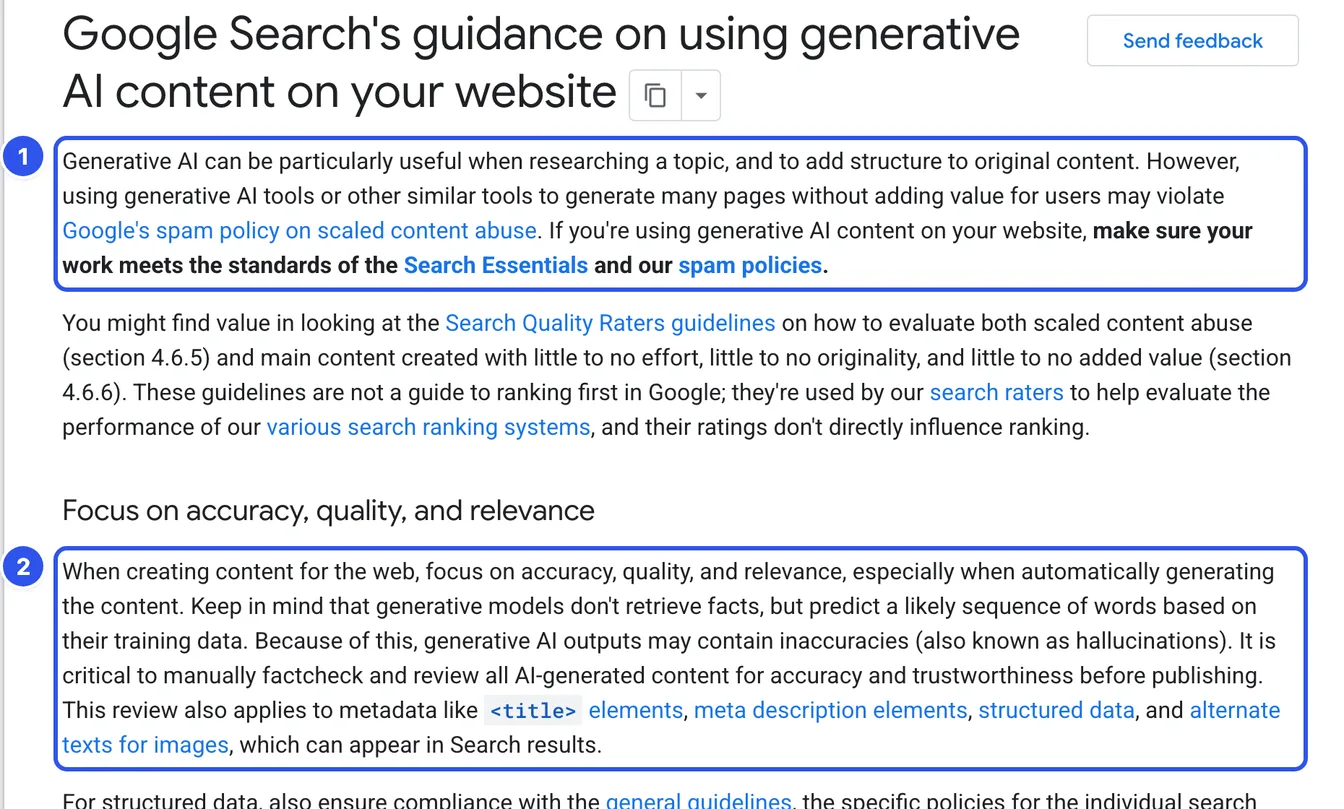
- Generative AI "can be particularly useful when researching a topic, and to add structure to original content." Generating many pages "without adding value for users" may violate the spam policy on scaled content abuse.
- Generative models "don't retrieve facts, but predict a likely sequence of words," so Google calls it "critical to manually factcheck and review all AI-generated content" before publishing, including titles, meta descriptions, structured data and alt text.
Google's spam policy defines scaled content abuse as many pages "generated for the primary purpose of manipulating search rankings and not helping users," and adds "no matter how it's created." In other words, the rule is about value, not about who or what typed the words.
That leaves a clear split of work. AI handles the parts that are mostly reading and structuring: pulling the current results, finding what they miss, drafting, checking metadata. People supply what no model has: first-hand experience, real numbers, an opinion, and the final check.
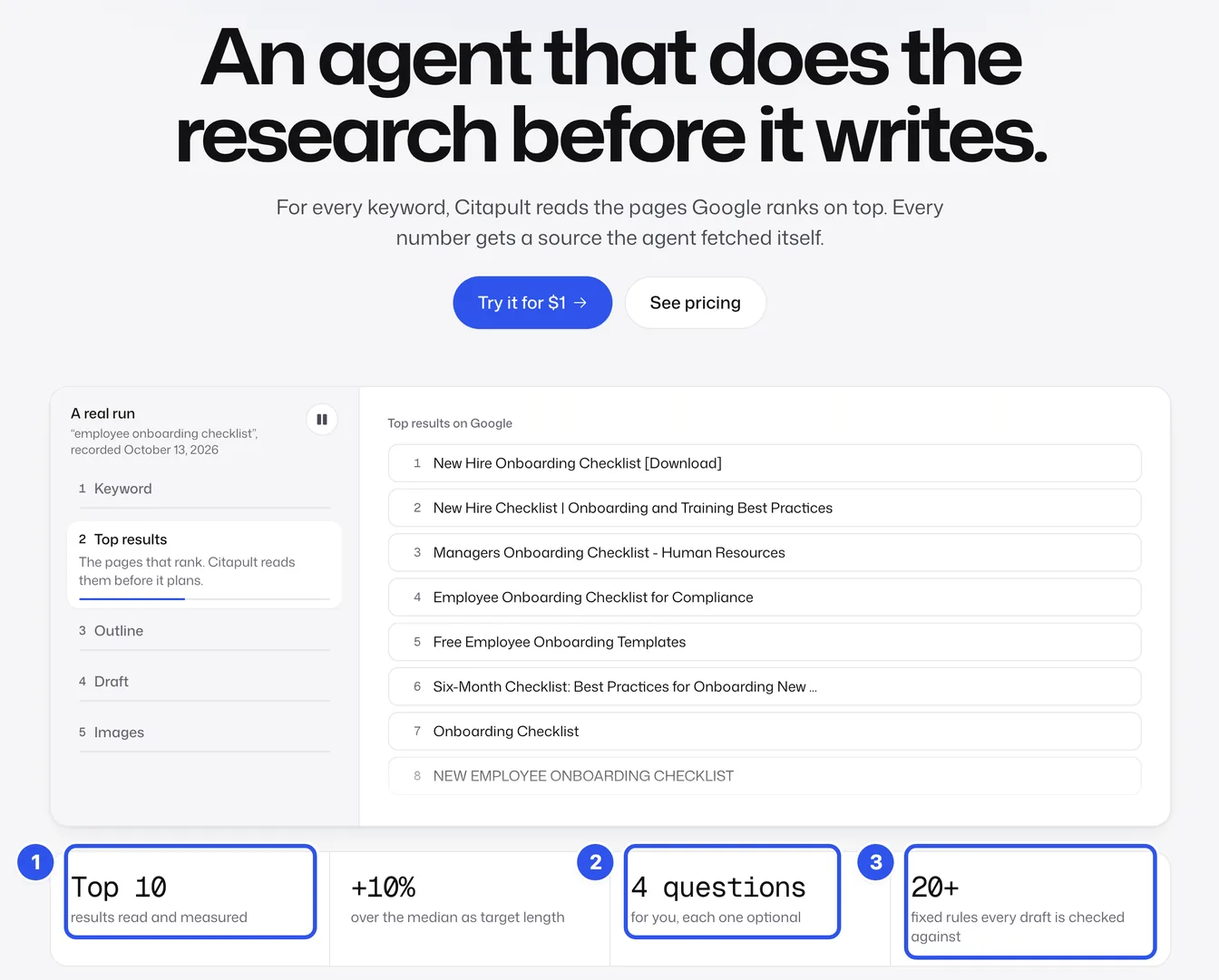
- Before writing, the agent reads and measures the top 10 Google results for the keyword: what they cover, what they miss and how long the article should be.
- It asks you four questions about real numbers, common mistakes and how you do things. Your answers go into the text, and you can skip any of them.
- Every draft is checked against 20+ fixed rules and revised until it passes: keyword placement, metadata length, at least 3 source domains, no AI filler phrases.
This is how Citapult's article agent splits the job: it does the research, sourcing and drafting an SEO content writer would do in steps 1 to 5, and asks you for the expertise Google looks for. Every number gets a source the agent fetched itself. You can read unedited example articles to judge the output before you try it.
For a company that needs 30 or more articles a month, an AI agent plus one person who reviews and adds expertise is often cheaper than a team of writers. For a handful of high-stakes pages (a pricing page, a medical guide, a flagship comparison), a specialist writer is still the better choice.
FAQ
What does an SEO content writer do?
They research what people search for, study the pages that rank, and write content that answers the query better. Then they optimize it with a clear title, meta description, headings, internal links and image alt text, and update it when rankings drop. CareerExplorer lists research, content creation, SEO optimization, editing, analytics and collaboration as the core duties.
What is SEO content writing?
SEO content writing is writing web content so that it ranks in search engines and helps the people who find it. Google calls this "people-first" content and says SEO "can be a helpful activity when it is applied to people-first content, rather than search engine-first content."
How much do SEO content writers make?
Upwork cites Glassdoor data with an average salary of $55,299 a year for a full-time SEO writer. Freelancers on Upwork typically charge $15, $25 or $35 an hour depending on experience. Indeed puts the average content writer in the United States at $23.97 an hour.
Is SEO a high paying job?
It depends on the role. Writing roles sit around the figures above. Upwork notes that SEO is in demand: its 2024 In-Demand Skills research ranked SEO as the second-most in-demand skill in sales and marketing. Writers who add strategy, analytics or a specialist niche can charge more than generalists.
Is SEO difficult to learn?
The basics are not. Google's free SEO Starter Guide covers titles, snippets, links and images in plain language. The hard part is judgment: reading search intent correctly and adding something the ranking pages don't have. That takes practice on real keywords.
Do I need an SEO content writer if I use AI?
You need someone to do the parts AI can't: supply first-hand expertise and check the facts. Google says it is "critical to manually factcheck and review all AI-generated content" before publishing. That person can be a writer, an editor or the subject expert in your company.
Sources
- 1careerexplorer.comWhat does a SEO writer do?
- 2upwork.comBest Freelance SEO Content Writers for Hire
- 3indeed.comContent writer salary in United States
- 4hawksem.comWhat Does an SEO Content Writer Do? (+ How to Write Content that Ranks)
- 5developers.google.comCreating helpful, reliable, people-first content
- 6developers.google.comSEO Starter Guide: The Basics
- 7developers.google.comGoogle Search's guidance on using generative AI content on your website
- 8developers.google.comSpam policies for Google web search
- 9reddit.comSEO content writer anxious about AI (thread)