LLM SEO: How to Get Your Pages Cited by ChatGPT, Perplexity and AI Overviews
LLM SEO explained: how ChatGPT, Perplexity and Google AI Overviews pick sources, what the GEO study found, which AI bots to allow and how to measure citations.
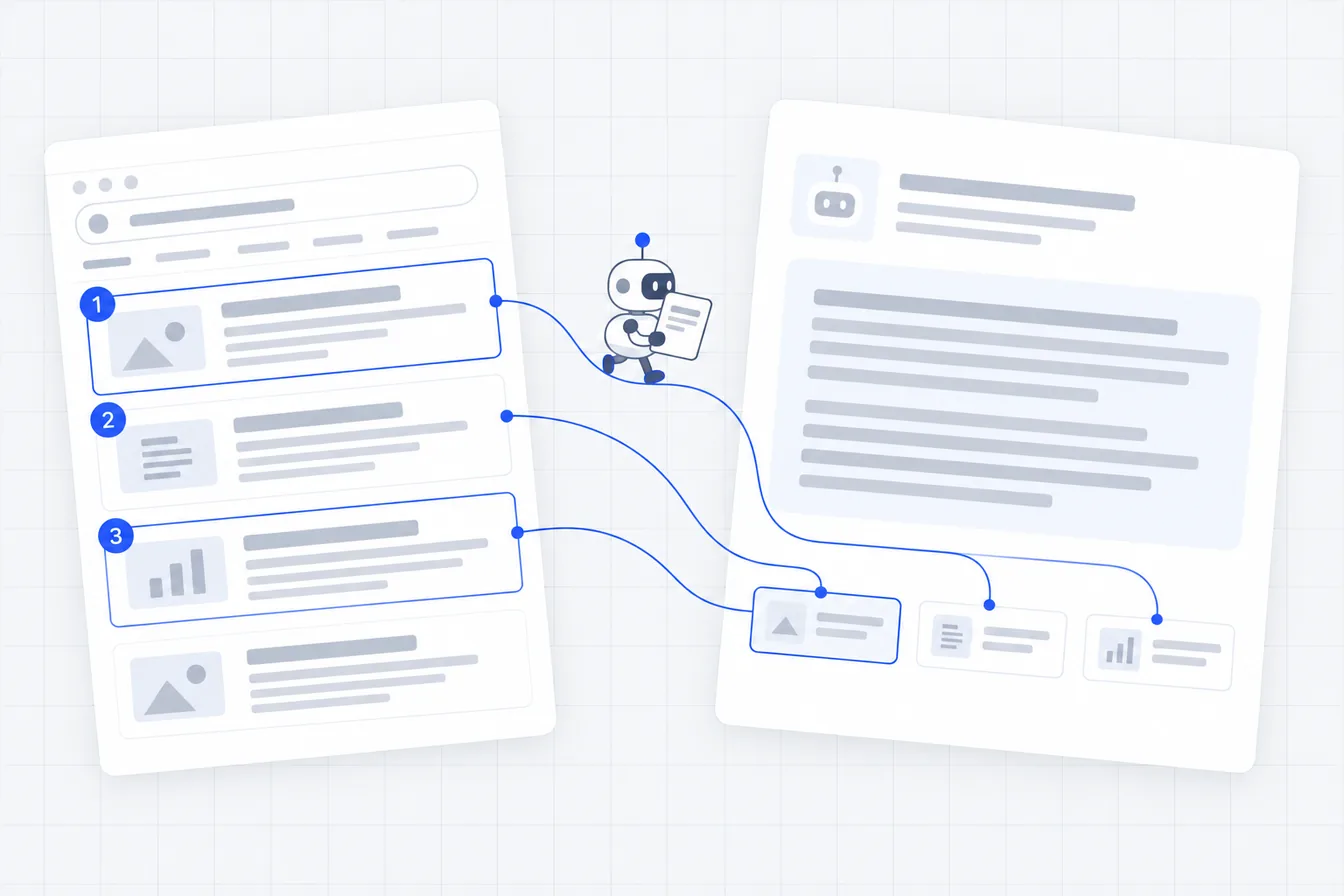
LLM SEO is the work of making your pages easy for large language models to find, understand and cite when they answer a question in ChatGPT, Perplexity, Gemini, Copilot or Google's AI Overviews. It builds on classic SEO, because most AI answers are grounded in pages that a search index has already crawled, and adds a layer on top: content that states its answer plainly, backs it with sources and can be quoted on its own.
TL;DR
You do not need a separate site or special files for LLM SEO. You need pages that AI crawlers can reach and read as text, that rank in the indexes AI tools search, and that answer questions in a form a model can lift and cite.
- Same foundation as SEO. Google says there are no extra requirements for AI Overviews or AI Mode: a page must be indexed and eligible for a snippet.
- The index matters. ChatGPT, Copilot and Meta AI use Bing's index, Google uses its own and Perplexity uses a mix, according to Vercel.
- Sources, quotes and statistics help. In the study that coined GEO, adding citations, quotations or statistics raised a page's visibility in AI answers by 30 to 40% on one metric. Keyword stuffing did not help.
- Check your robots.txt. Blocking OAI-SearchBot keeps you out of ChatGPT search answers, while blocking GPTBot only opts you out of training.
- Measure citations, not just rankings. Bing Webmaster Tools now reports Copilot citations, and AI referrer traffic shows up in your analytics.
What is LLM SEO, and what is it called?
LLM stands for large language model, the kind of AI behind ChatGPT, Gemini, Claude and Perplexity. "LLM in SEO" can mean two things: using a model to help with SEO work, or optimizing your site so that these models show it in their answers. This guide is about the second meaning, which is what most people search for.
The discipline has several names. Vercel lists five in one sentence: "Call it LLM SEO, Language Engine Optimization (LEO), Generative Engine Optimization (GEO), Answer Engine Optimization (AEO), or AI SEO, the goal is the same" (Vercel). Semrush uses LLMO, short for large language model optimization (Semrush). GEO is the name the academic research uses, and our comparison of GEO vs SEO goes deeper into how the two relate.
One word of warning if you research the topic: "LLM optimization" also refers to making the models themselves run faster and more accurately. Search results for "what is LLM optimization" mix both meanings, so check whether an article is about marketing or about model inference before you read on.
Vercel's own definition is the shortest: "LLM SEO is the art of becoming the answer." In practice, that means three outcomes you can check for any question your customers ask:
- Mentioned: the AI answer names your brand.
- Cited: it links one of your pages as a source.
- Recommended: it suggests you as the option to pick.
Why LLM SEO matters now
AI answers take clicks that used to go to search results. Pew Research Center analyzed the Google searches of 900 U.S. adults in March 2025. When a search showed an AI summary, users clicked a regular result in 8% of visits, against 15% when there was none (Pew Research Center).
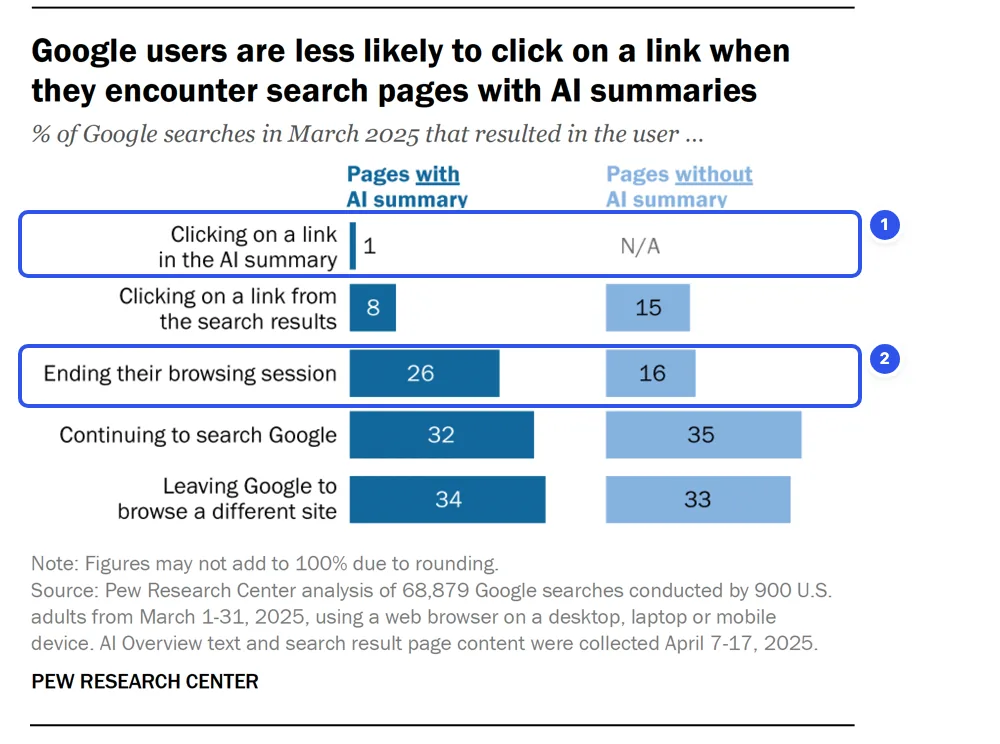
- Users clicked a link inside the AI summary in just 1% of visits.
- They ended their browsing session on 26% of pages with a summary, against 16% without one.
The same study shows which searches trigger these answers. Overall, 18% of searches produced an AI summary. That rose to 53% for searches of 10 words or more and to 60% for searches that began with a question word such as "who," "what," "when" or "why." The typical summary was 67 words long, and 88% of them cited three or more sources. Wikipedia, YouTube and Reddit were the most cited sources and accounted for 15% of all sources in the summaries.
The other side of the picture: people who do click from an AI answer often arrive ready to act. ChatGPT now refers around 10% of new Vercel signups, up from 4.8% the previous month and 1% six months earlier. Vercel also reports that the form builder Tally grew from $2M to $3M ARR in four months, with ChatGPT and Perplexity driving the majority of its new signups (Vercel).
How LLMs find and choose your content
LLMs reach your content in two ways, and LLM SEO has to serve both.
Training. A model learns from web content collected before its training cutoff. What it learned there shapes how it describes your brand and topic even when it does not search. Vercel puts it this way: "You need to support both real-time retrieval and long-term inclusion in training data."
Retrieval. When ChatGPT search, Perplexity, Copilot or Google's AI features answer a question, they run searches, read the top pages and write an answer with links. This is where most LLM SEO work pays off, because you can influence it page by page. Three details decide whether your page gets read:
- Which index the tool searches. "ChatGPT, Copilot, and Meta AI use Bing's index. Google uses its own. Perplexity uses a mix," according to Vercel. If your pages are missing or rank poorly in Bing, ChatGPT is less likely to find them.
- Whether the page is eligible. For Google, a page must be indexed and eligible to be shown in Search with a snippet to appear as a supporting link in AI Overviews or AI Mode (Google Search Central).
- How many searches run behind one question. Google says both AI Overviews and AI Mode may use a "query fan-out" technique, "issuing multiple related searches across subtopics and data sources" to build a response. A page that answers a sub-question clearly can be cited even when it does not rank for the main query.
Then the model decides what to quote. Vercel notes that "even if indexed, a page may be skipped if meaning isn't clear or the layout is hard to parse." That is the gap LLM SEO closes.
LLM SEO vs traditional SEO
LLM SEO is not a replacement for SEO; Vercel calls it "an adaptation." The table shows where the work overlaps and where it differs.
| Aspect | Traditional SEO | LLM SEO |
|---|---|---|
| Goal | Rank a page in the list of results | Be named, cited or recommended inside the answer |
| Where it shows | Google and Bing results pages | ChatGPT, Perplexity, Gemini, Copilot, AI Overviews and AI Mode |
| Unit that wins | The whole page | A passage, number or quote that answers one question |
| Index | Google and Bing | Bing for ChatGPT and Copilot, Google for its AI features, a mix for Perplexity |
| What helps | Relevance, links, technical health | The same, plus clear answers, cited sources, quotations and statistics |
| Keyword stuffing | Outdated | Performed 10% worse than baseline on Perplexity in the GEO study |
| Main metric | Rankings, clicks, impressions | Citations, mentions and AI referrer visits |
| Data from the engine | Search Console, Bing Webmaster Tools | Bing AI Performance; Search Console's generative AI performance report (impressions only) |
What the research says works
The best evidence comes from the paper that coined the term generative engine optimization, by Pranjal Aggarwal and colleagues, first submitted to arXiv on 16 Nov 2023 (arXiv). The authors rewrote web pages with nine methods and measured how much of an AI answer drew on each page. Their headline finding: GEO "can boost visibility by up to 40% in generative engine responses."
Three methods did best. Cite Sources, Quotation Addition and Statistics Addition "achieved a relative improvement of 30-40% on the Position-Adjusted Word Count metric and 15-30% on the Subjective Impression metric." Keyword stuffing, the reflex of old-school SEO, did not perform well, and on Perplexity it was 10% worse than the baseline. The best pair of methods was Fluency Optimization combined with Statistics Addition.
The most useful result for smaller sites is in the paper's Table 2, which splits the gains by where a page ranked in the search results.
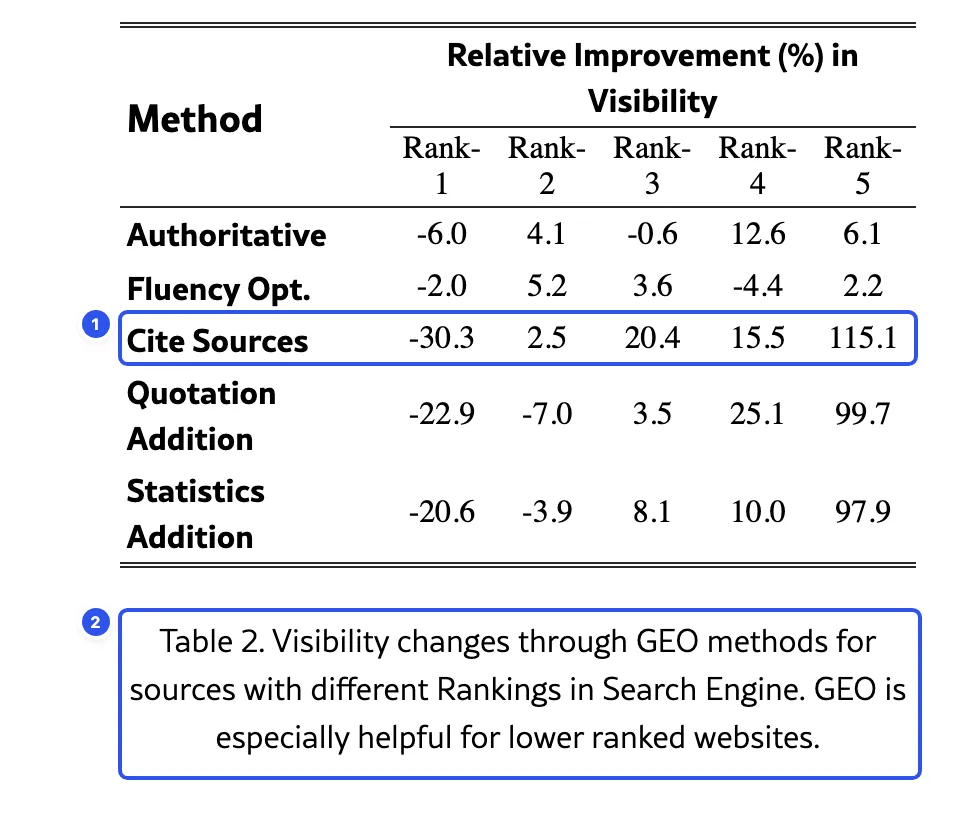
- Cite Sources lowered visibility by 30.3% for the page ranked first, but raised it by 115.1% for the page ranked fifth.
- The authors' own conclusion: "GEO is especially helpful for lower ranked websites."
Quotation Addition (99.7%) and Statistics Addition (97.9%) show the same pattern for the fifth-ranked page. In plain terms: if you are not the top result, a well-sourced page can still win a larger share of the answer.
LLM SEO checklist: 10 practices that hold up
Google's guidance is blunt: "There are no additional requirements to appear in AI Overviews or AI Mode, nor other special optimizations necessary." Its list of practices is the SEO list you already know.
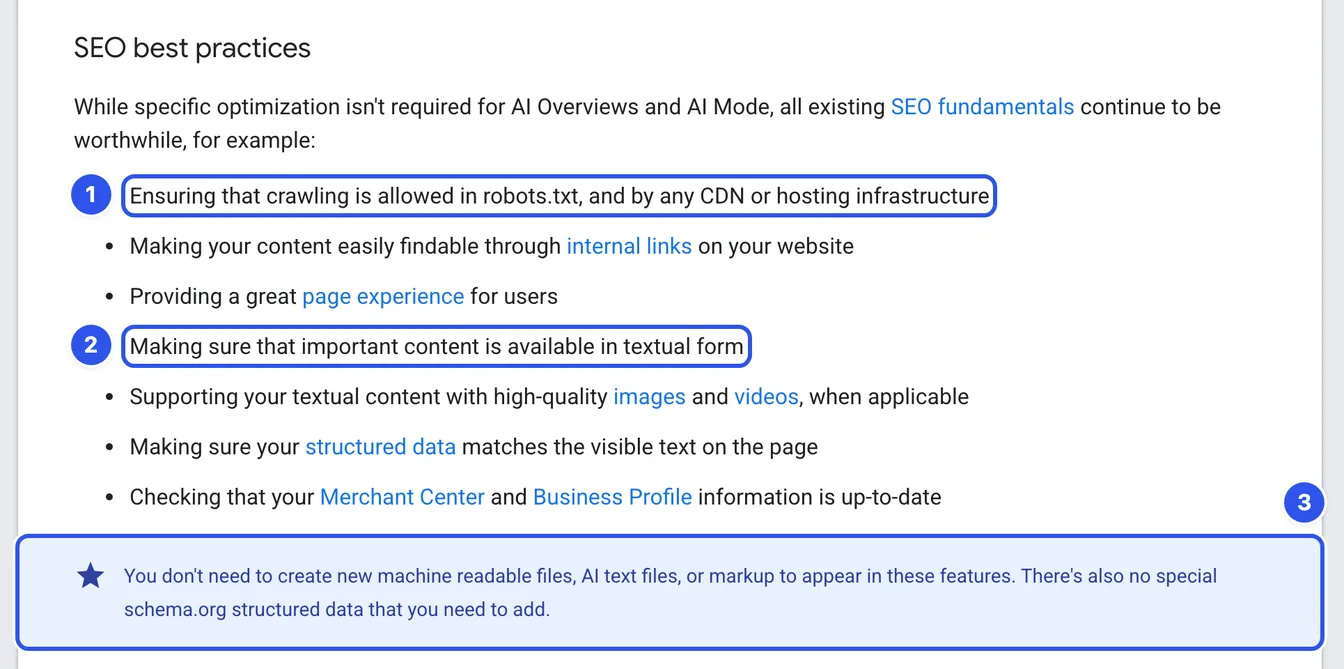
- Crawling must be allowed in robots.txt and by any CDN or hosting infrastructure.
- Important content should be available in textual form.
- Google states you do not need machine readable files, AI text files, special markup or schema.org data for these features.
Combine that with what Vercel, the GEO study and the AI companies' crawler docs say, and you get this LLM SEO checklist:
- Let the right crawlers in. Check robots.txt and your CDN or firewall for Googlebot, Bingbot, OAI-SearchBot, PerplexityBot and Claude-SearchBot (details in the next section).
- Get indexed in Bing as well as Google. Use Google Search Console and Bing Webmaster Tools to track indexing, and keep a clean, accurate sitemap.
- Serve content as HTML. "Most AI crawlers fetch but do not execute JavaScript," so Vercel recommends server-side rendering, static generation or incremental static regeneration for anything you want read.
- Answer first. Put a short, self-contained answer under each heading. Vercel calls this "Write for extraction."
- Cite your sources in the sentence. Link the study or official page that backs each number. This is the method with the strongest effect in the GEO paper.
- Add statistics and quotations. Concrete numbers and quotes from relevant sources were the other two top methods.
- Use tables and lists for comparisons. They are easy to parse and easy to quote.
- Publish what others cannot copy. Original data, code, expert quotes or stories. Vercel's litmus test: "Could a competitor easily replicate this tomorrow?"
- Keep pages fresh. "Over time, stale content becomes less useful," and in retrieval systems "newer, higher-ranking content is more likely to be included."
- Earn real links, skip paid ones. "For retrieval, backlinks and indexability still remain critical," Vercel writes, and it advises: "Avoid paid links."
Most of this checklist is writing discipline, and it is hard to keep up across dozens of posts. This is what Citapult's GEO articles are built around: every article opens with a TL;DR that answers the query in 2 to 3 sentences, every heading starts with its answer, every number is sourced in the same sentence from a page the agent read, and each article carries Article JSON-LD with author, publisher and dates. For a broader walkthrough of on-page work, see our guide on how to optimize content for AI search engines.
Crawler access: which AI bots to allow
Each AI company runs separate bots for search and for training, and the difference matters for LLM SEO. Blocking a training bot keeps your content out of future models. Blocking a search bot keeps you out of the answers today.
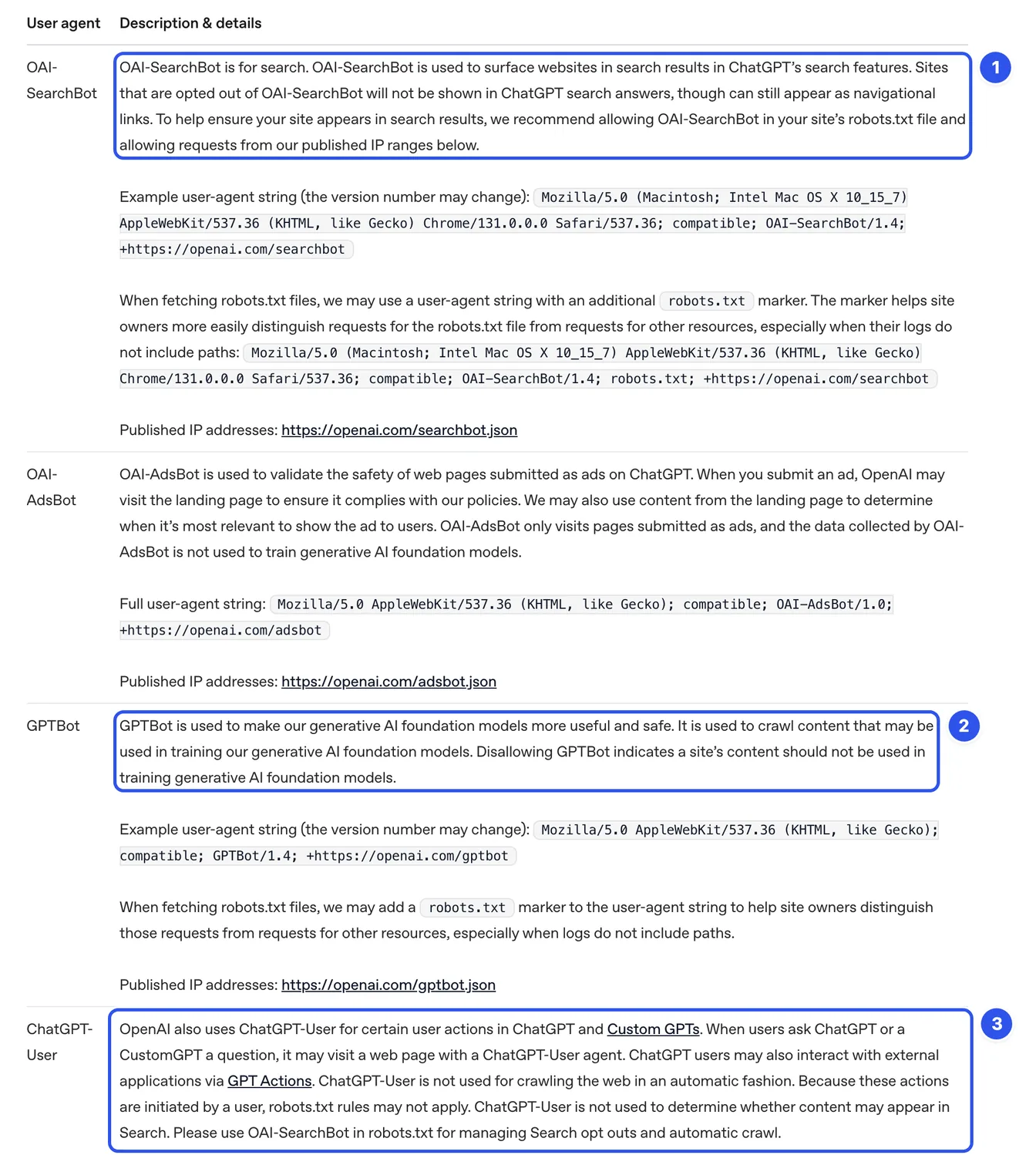
- OAI-SearchBot is for search: sites that opt out "will not be shown in ChatGPT search answers, though can still appear as navigational links."
- GPTBot crawls content that may be used to train OpenAI's foundation models. Disallowing it opts you out of training only.
- ChatGPT-User makes visits that users start in ChatGPT. Because a user starts them, "robots.txt rules may not apply."
| Company | Search bot (allow for visibility) | Training bot | User-initiated fetcher |
|---|---|---|---|
| OpenAI | OAI-SearchBot | GPTBot | ChatGPT-User, robots.txt may not apply |
| Perplexity | PerplexityBot, not used for training | None listed | Perplexity-User, generally ignores robots.txt |
| Anthropic | Claude-SearchBot | ClaudeBot | Claude-User |
| Googlebot (AI Overviews and AI Mode use Search) | Google-Extended token | None listed |
A few details from the official docs:
- OpenAI says changes to robots.txt can take about 24 hours to apply to search results (OpenAI).
- Perplexity recommends allowing PerplexityBot and its published IP ranges, and says the bot "is not used to crawl content for AI foundation models" (Perplexity).
- Anthropic warns that disabling Claude-SearchBot "may reduce your site's visibility and accuracy in user search results." As of October 30, 2026, it also recognizes a machine-readable signal, based on IETF aipref work, for opting out of AI training (Anthropic).
- Google-Extended controls whether content is used for Gemini training and grounding, and Google says it "does not impact a site's inclusion in Google Search nor is it used as a ranking signal" (Google). To limit what Google's AI features show from a page, Google points to nosnippet, data-nosnippet, max-snippet or noindex instead.
How to measure LLM SEO
An LLM SEO check starts with the data the engines give you, then fills the gaps by asking the AI tools directly. Vercel is frank about the limits: "There's no reliable dashboard showing if your content appears in answers or is embedded in training data."
| Signal | Where to find it | What it tells you |
|---|---|---|
| Copilot and Bing AI citations | Bing Webmaster Tools, AI Performance | Total citations, cited pages and the grounding queries that led to them |
| Google AI Overviews and AI Mode | Search Console, generative AI performance report and the "Web" search type | Impressions by page, country, device and date in the AI report; clicks only mixed into "Web" |
| AI referrer traffic | Your web analytics | Visits from chat.openai.com, perplexity.ai, claude.ai and similar |
| Mentions, citations, recommendations | Prompt tracking tools | Whether each AI names or links you for the questions you care about |
Microsoft introduced AI Performance in Bing Webmaster Tools as a public preview. It shows how content appears across Microsoft Copilot, AI-generated summaries in Bing and select partner integrations, and it recommends IndexNow so AI systems see the current version of a page (Microsoft Bing). On Google's side, clicks from AI features are counted in the Performance report under the "Web" search type, and Google says clicks from pages with AI Overviews are "higher quality." Since August 31, 2026, every site also has a generative AI performance report that shows how often its pages appeared in AI Overviews and AI Mode; it has no click data (Search Console Help).
None of these sources tells you what ChatGPT, Perplexity or Gemini actually say about you. For that you need an LLM SEO checker that asks them your customers' questions on a schedule. Our overview of LLM SEO tools compares the options, and if Google is your main concern, read how an AI Overviews tracker works.
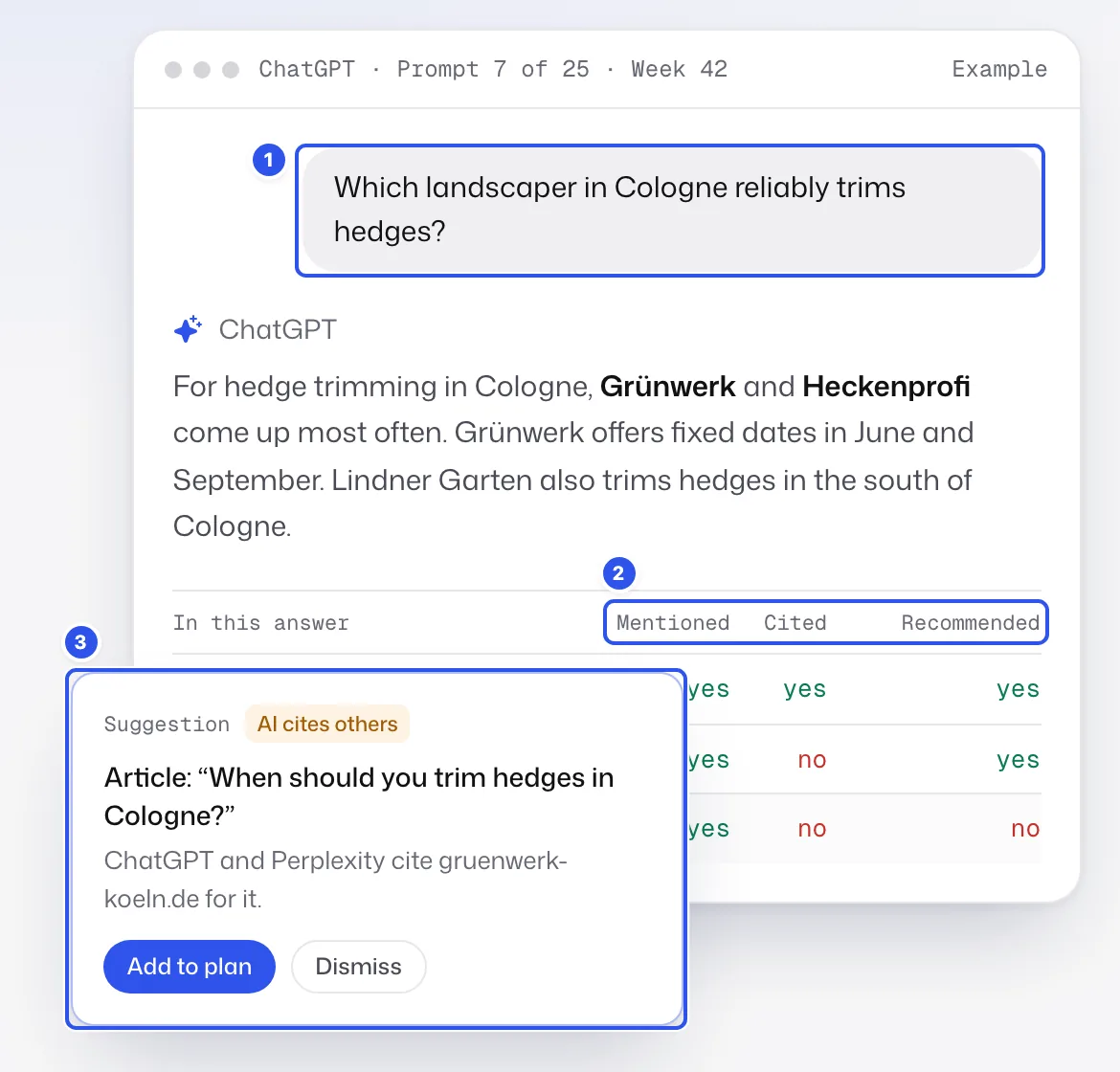
- One of the tracked prompts, a question a customer would ask ChatGPT.
- For each answer: is the brand mentioned, cited as a source, recommended?
- Where the AI cites a competitor, the gap becomes a suggestion for an article.
Citapult Visibility asks ChatGPT, Google AI Overview, Google AI Mode, Perplexity and Gemini your prompts every week, compares the answers against the competitors you confirm and checks your Google positions down to 100. Where others get cited, you get a suggestion; with Citapult Articles, an approved suggestion becomes a written post with sources.
Common LLM SEO mistakes
- Blocking the search bots along with the training bots. A blanket "block all AI" rule in robots.txt or a firewall also blocks OAI-SearchBot, PerplexityBot and Claude-SearchBot, and with them your chance to be cited.
- Hiding content behind JavaScript. If the text only appears after scripts run, most AI crawlers never see it.
- Treating llms.txt as required. llms.txt is a proposal for a markdown file that helps AI agents read a site. Its authors report that thousands of sites publish one and that Chrome's Lighthouse audits for it (llmstxt.org). Google, though, says you do not need "new machine readable files, AI text files, or markup" for AI Overviews or AI Mode. Add one if it is cheap, but do not expect it to fix crawl or content problems.
- Stuffing keywords. It did not help in the GEO study and hurt on Perplexity. Vercel adds that legacy tactics like keyword stuffing or hidden text "don't help."
- Ignoring Bing. ChatGPT and Copilot use Bing's index, so a site that only watches Google can miss why it never shows up in ChatGPT.
- Writing pages that only make sense as a whole. An AI quotes a passage, not a page. Answers buried in the fourth paragraph, numbers without sources and headings that tease instead of answer are all easy to skip.
- Letting pages go stale. Retrieval favors newer, accurate content, so update key pages when facts change and keep your sitemap accurate.
FAQ
Is there SEO for LLMs?
Yes. It is usually called LLM SEO, LLMO, GEO or AEO, and it means making pages easy for AI tools to find, read and cite. Most of it is classic SEO, since Google says AI Overviews and AI Mode have no extra requirements beyond being indexed and eligible for a snippet.
What is LLM SEO called?
LLM SEO goes by several names: LLMO (large language model optimization), GEO (generative engine optimization), AEO (answer engine optimization), LEO (language engine optimization) and AI SEO. They describe the same goal of appearing in AI-generated answers.
What is the difference between SEO and LLM SEO?
SEO aims to rank a page in the list of search results, while LLM SEO aims to get a page named, cited or recommended inside an AI answer. The foundation is shared, but LLM SEO adds answer-first writing, cited sources and statistics, and it measures citations instead of positions.
What does an LLM optimizer do?
An LLM optimizer makes sure AI crawlers can reach a site, that key pages are indexed in Google and Bing, and that content answers questions in quotable passages with sources. They also track how often AI tools mention, cite or recommend the brand and close the gaps where competitors get cited instead.
Which LLM is best for SEO?
No single model is best for every SEO task, and the more useful question for visibility is which AI tools your customers use. Track your brand in the ones that matter to your market, such as ChatGPT, Perplexity, Gemini, Copilot and Google's AI features, rather than optimizing for one model.
Do I need an llms.txt file for LLM SEO?
No. Google says you do not need AI text files or special markup to appear in AI Overviews or AI Mode. llms.txt is a proposal that some sites and tools support, so it can help AI agents read your docs, but it does not replace crawlable, well-written pages.
Sources
- 1vercel.comHow Vercel's adapting SEO for LLMs and AI search
- 2developers.google.comAI features and your website
- 3pewresearch.orgGoogle users are less likely to click on links when an AI summary appears in the results
- 4arxiv.orgGEO: Generative Engine Optimization
- 5arxiv.orgfull HTML version
- 6developers.openai.comOverview of OpenAI Crawlers
- 7docs.perplexity.aiPerplexity Crawlers
- 8support.claude.comDoes Anthropic crawl data from the web, and how can site owners block the crawler?
- 9developers.google.comGoogle's common crawlers
- 10blogs.bing.comIntroducing AI Performance in Bing Webmaster Tools Public Preview
- 11llmstxt.orgThe /llms.txt file, v2
- 12semrush.comLLM Optimization (LLMO): Get AI to Talk About Your Brand
- 13support.google.comGenerative AI performance report (Search)