Best Generative Engine Optimization Tools: 11 Picks for 2026, Sorted by Job
The best generative engine optimization tools sorted by job: free AI citation data, crawler control, trackers from €29 a month and tools that fix gaps.

The best generative engine optimization tools cover three jobs: they let AI crawlers reach your pages, they measure how often ChatGPT, Perplexity, Gemini and Google's AI features mention or cite you, and they help you fix the pages that lose. No single tool does all three well. Below are 11 tools we checked on their live pages on November 12, 2026, grouped by the job each one does best, with prices, engines and limits.
TL;DR
- Start free. Bing Webmaster Tools reports real citation counts from Copilot and Bing's AI summaries, and Cloudflare's AI Crawl Control shows which AI bots reach your site on every Cloudflare plan.
- Cheapest tracking: Otterly.AI Lite at €29 a month (20 prompts on 3 engines; every plan can track all 7), and it includes a GEO audit of crawlability and content.
- Already on Semrush or Ahrefs? The Semrush AI Visibility Toolkit costs $99 a month, and Ahrefs includes custom prompt tracking in every paid plan from Lite up.
- Tracking plus content: Writesonic bundles 50 prompts, 15 AI articles and 10 site audits from $79 a month (billed annually). Citapult turns each gap it finds into a sourced article.
- Enterprise and AI agents: Profound and Scrunch, with up to 10 and 9 engines on their top plans.
What a GEO tool has to do
Generative engine optimization (GEO) means getting your pages used as sources in AI-generated answers. The term comes from a 2023 research paper, accepted to KDD 2024, whose authors showed that GEO methods can boost a page's visibility in generative engine responses by up to 40%. If you want the background first, read our guide to LLM SEO.
In practice the work splits into three jobs, and every tool on this list does at least one of them:
| Job | The question it answers | What the tool needs |
|---|---|---|
| 1. Get read | Can AI crawlers fetch my pages at all? | Crawler logs, robots.txt checks, bot rules |
| 2. Get measured | Do AI answers mention, cite or recommend me, and who wins instead? | A set of prompts run on several engines, with source tracking |
| 3. Get chosen | What should I change or write so the answer cites me? | Recommendations, audits, or content creation |
Most "best GEO tools" lists only cover job 2. That is the part with dashboards, but it is the least useful on its own: a chart that says a competitor gets cited does not fix anything.
One thing you do not need to buy. Google says there are "no additional requirements" to appear in AI Overviews or AI Mode, and that you "don't need to create new machine readable files, AI text files, or markup" for these features (Google Search Central). A page must be indexed and eligible to show with a snippet, and crawling has to be allowed in robots.txt and by your CDN or hosting. Traffic from these features lands in Search Console's Performance report under the "Web" search type, mixed with regular results. So Search Console is your free baseline, but it cannot tell you which clicks came from an AI answer. Since August 31, 2026, its generative AI performance report does show how often your pages appeared in AI Overviews and AI Mode, as impressions by page, country, device and date (Search Console Help).
How we picked and compared the tools
We opened each tool's pricing or product page on November 12, 2026 and noted five things:
- Job: which of the three jobs above it covers.
- Engines: which AI answer engines the entry plan checks.
- Prompts for the money: how many tracked questions the entry price buys.
- Action: whether it only reports or also helps you fix gaps (audits, recommendations, content).
- Trial: whether you can test it before paying.
Several vendors showed euro prices because of our location; you may see dollars. Citapult is our own product. We list it with the same kind of facts as every other tool, taken from its public pages, and say where another tool fits better.
1. Bing Webmaster Tools AI Performance: best free GEO tool
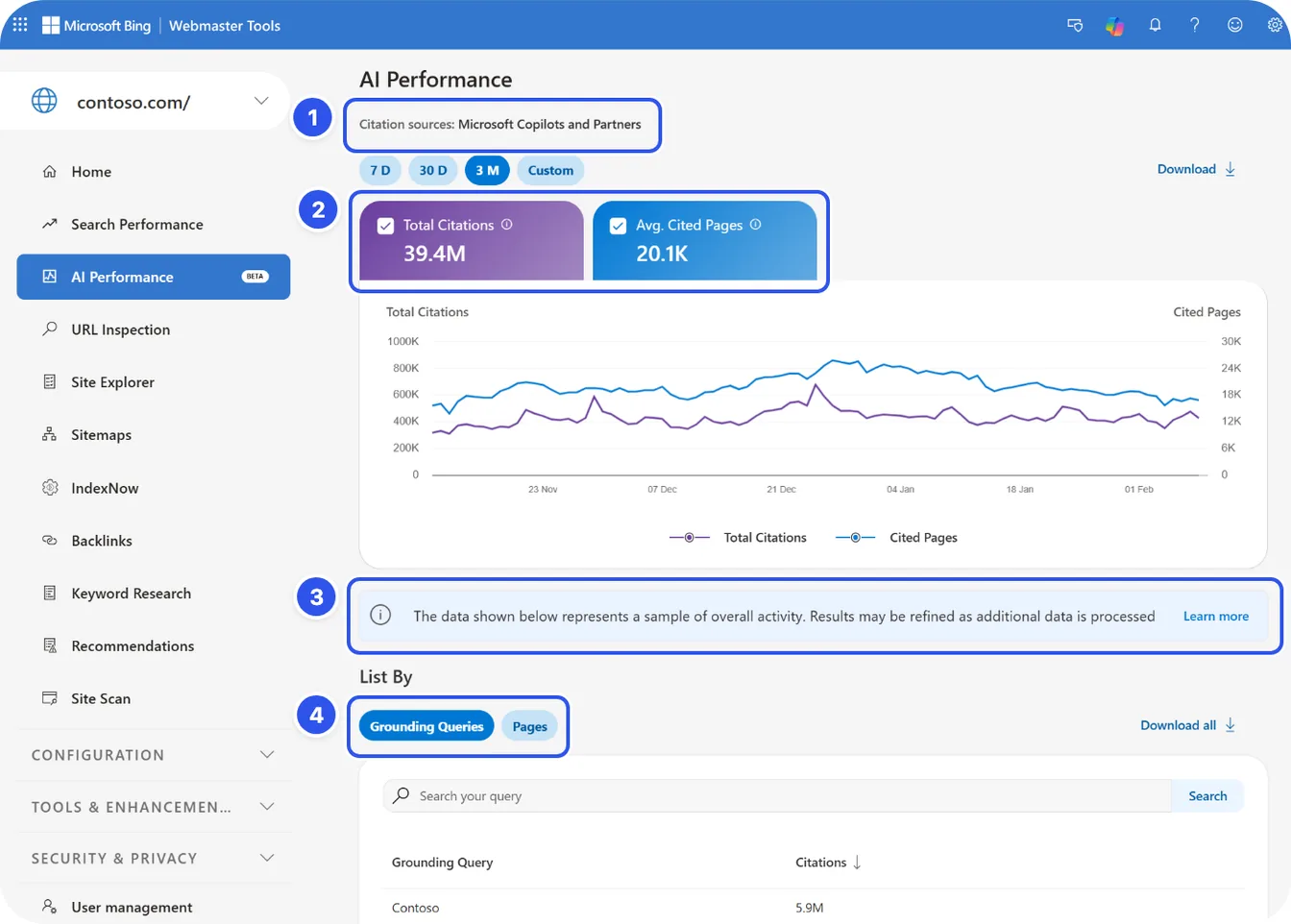
- Where the data comes from: Microsoft Copilot and partner integrations.
- Total Citations and Average Cited Pages for the selected period.
- Microsoft's note that the table below is a sample of overall activity.
- Grounding queries: the phrases the AI used when it retrieved your content.
Job: get measured (with real data). Microsoft introduced AI Performance as a public preview on February 10, 2026. It shows how often your content is cited across Microsoft Copilot, AI-generated summaries in Bing and select partner integrations. Every other tracker on this list asks an engine a question and parses the answer. This one reports actual citations of your pages, plus page-level citation counts and a timeline.
Best for: every site owner, as the first GEO report to open. The grounding queries show which phrasings already lead AI to you. Limit: Microsoft surfaces only, no competitor view, and the query table is a sample.
2. Cloudflare AI Crawl Control: best for letting the right AI bots in
Job: get read. If your site runs on Cloudflare, AI Crawl Control (formerly AI Audit) is "available on all plans" and works without configuration, according to Cloudflare's documentation. It shows which AI services access your content, lets you allow or block individual crawlers, and tracks which crawlers follow your robots.txt directives. A pay-per-crawl option for charging AI crawlers is in private beta.
This matters for GEO because a CDN rule can silently block the crawlers that feed AI answers, and Google names CDN and hosting rules next to robots.txt as places to check.
Best for: sites on Cloudflare that want to see and control AI bot traffic before they spend on tracking. Limit: it measures access, not answers. It will not tell you whether ChatGPT recommends you.
3. Otterly.AI: best budget tracker, with a GEO audit
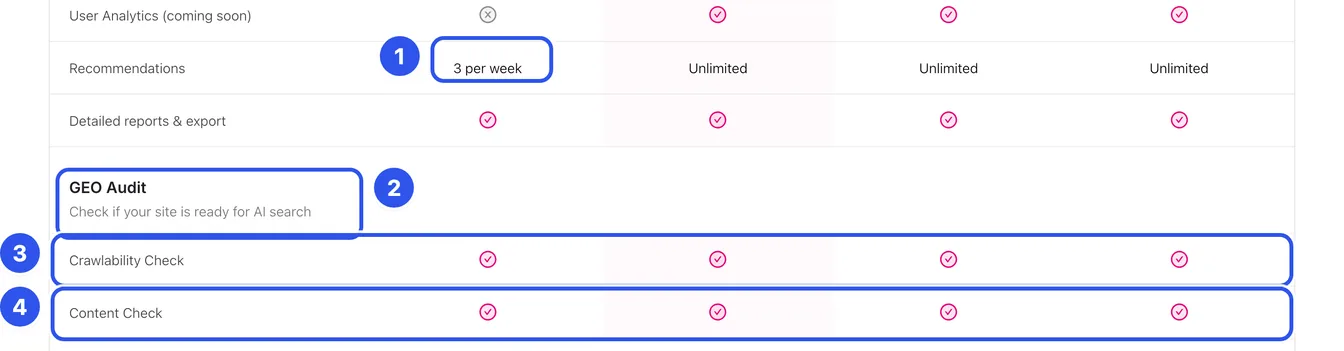
- Lite gets 3 recommendations per week; the paid tiers above it get unlimited.
- The GEO Audit section: "Check if your site is ready for AI search."
- Crawlability Check, included in every plan.
- Content Check, also in every plan.
Jobs: get measured, plus a light version of get read and get chosen. Otterly's Lite plan costs €29 a month for 2,000 credits, enough for 20 prompts tracked daily on 3 engines. Every plan can track all 7 engines (ChatGPT, Google AI Overviews, Perplexity, Microsoft Copilot, Google AI Mode, Gemini and Claude), but each engine uses credits, so adding engines lowers the number of prompts you can track. Standard costs €189 for 160 prompts and Premium €489 for 535. Every plan includes unlimited brands, competitors, countries and team members, citation source tracking, and the GEO audit shown above. One detail worth knowing: a Claude answer counts as 3 credits, all other engines as 1. There is a free trial, and annual billing saves 15%.
Best for: solo marketers and small teams who want daily data and a basic site check for little money. Limit: 20 prompts covers one product line at most, and the jump to Standard is large.
4. Peec AI: best for teams that want to know which sources to win
Jobs: get measured, get chosen. Peec AI starts at €85 a month (Starter) for 50 prompts, 3 models of your choice and daily tracking. Pro costs €205 for 150 prompts and Advanced €425 for 350 prompts and 5 projects. Every plan has unlimited users. The models to choose from include ChatGPT, Perplexity, AI Overviews, AI Mode and Gemini; Enterprise tracks up to 26.
What makes Peec useful for GEO rather than just reporting is the source layer. It classifies each source as competitor, editorial, reference or UGC, and lists sources that often name competitors but not you. Every plan also includes gap analysis, recommended actions grouped into earned and owned, agent actions, and a crawlability audit that checks which of 40+ AI bots your robots.txt allows. There is a free trial.
Best for: marketing teams and agencies who need to know which publications and pages to get into. Limit: 3 models on the paid plans, and prices step up quickly.
5. SE Visible: most prompts per euro
Job: get measured. SE Ranking's standalone AI visibility tool, SE Visible, starts at €80 a month (€64 billed annually) for 75 tracked prompts, 5 projects, unlimited user seats and daily tracking. Core costs €169 (€135 annually) for 200 prompts, and Agency €355 (€284 annually) for 1,000 prompts and 30 projects. There is a 10-day free trial.
Every SE Visible plan checks ChatGPT, AI Overviews, AI Mode, Gemini and Copilot the way users see them, with web search and cited links. From the Agency plan it also asks Claude directly without web search, which shows what the model "knows" about your brand from memory, including outdated prices. SE Visible is included in every plan of SE Ranking's SEO platform, which starts at €87 a month.
Best for: teams that want many prompts on a mid-range budget. Limit: the Claude memory check only starts at Agency, and the tool reports rather than writes.
6. Semrush AI Visibility Toolkit: best inside an SEO suite
Jobs: get measured, get read. The AI Visibility Toolkit costs $99 a month and has no free trial. It includes 25 prompts for daily prompt tracking on platforms like Google AI Mode and ChatGPT, 300 daily queries in AI analysis reports, 1,000 daily queries in Prompt Research, and AI search checks in Site Audit for up to 100 pages. Prompt Research works like keyword research for AI, with topic-level volume, difficulty and intent. The Semrush One bundles raise prompt tracking to 50, 100 or 200 prompts, and 50 extra prompts cost $60 a month.
Best for: teams that already live in Semrush and want AI prompts next to their keyword data. Limit: 25 tracked prompts is thin for the price, and each extra user needs another $99 license.
7. Ahrefs Brand Radar: best for benchmarking a whole market
Job: get measured. Brand Radar has two parts. Custom prompts track questions you define, start at €47 a month, and come free with every paid Ahrefs plan from Lite up. The AI Visibility Index starts at €179 a month and covers 558 million prompts across AI Overviews, AI Mode, ChatGPT, Perplexity, Gemini and Copilot, with Claude available; Ahrefs lists €654 a month for all models. Because each prompt maps back to real search demand, you can see which high-volume topics trigger AI answers and which domains get cited.
Best for: Ahrefs customers, and anyone who wants share of voice across a market without writing prompts first. Limit: the index works best once your brand already appears in AI answers, as Ahrefs itself notes, and prices are exclusive of tax.
8. Writesonic: tracking, articles and audits in one plan
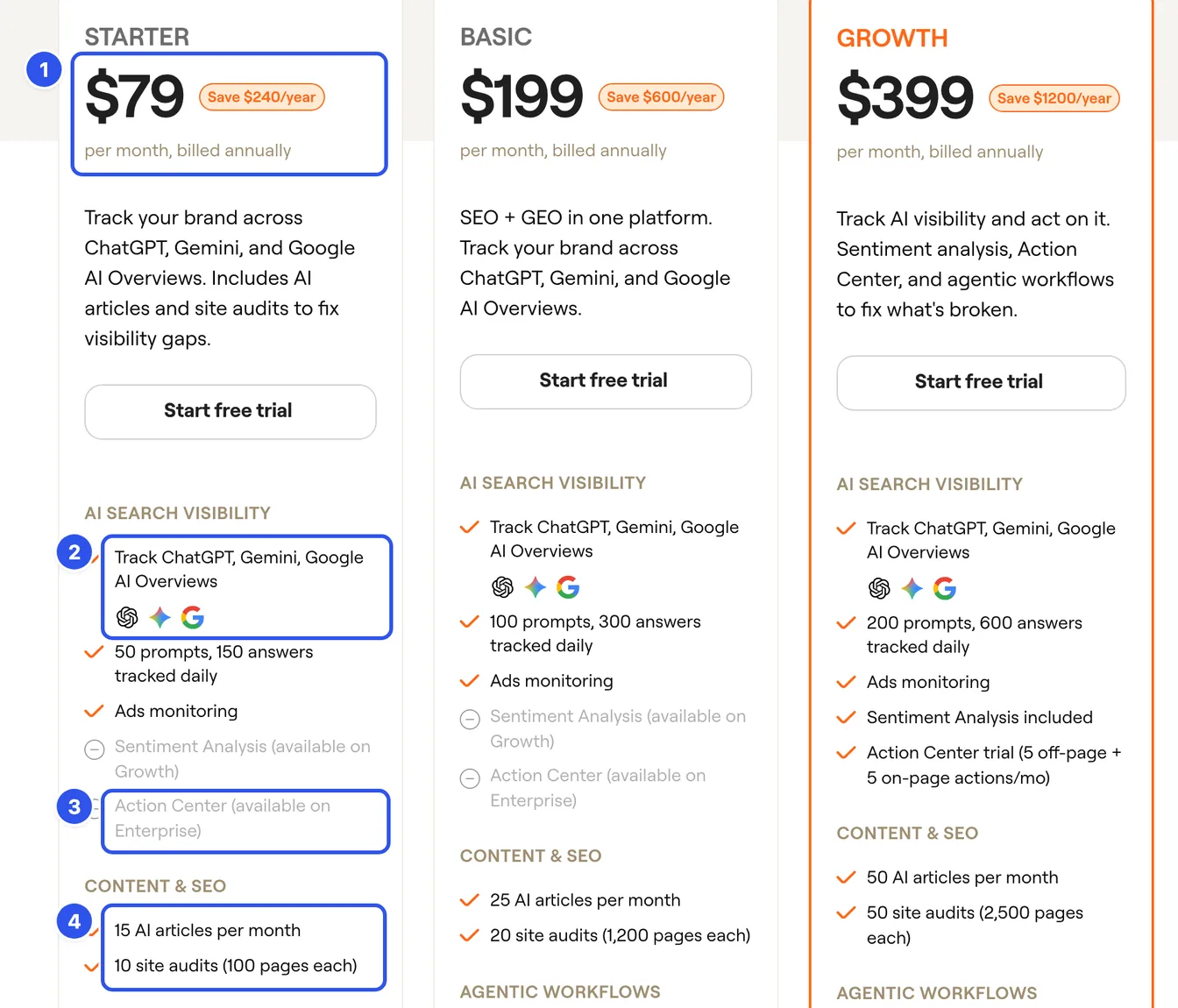
- Starter at $79 per month, billed annually.
- The engines tracked on Starter: ChatGPT, Gemini and Google AI Overviews.
- Action Center, Writesonic's fix workflow, is only on Enterprise (Growth gets a trial with 5 off-page and 5 on-page actions a month).
- The content side: 15 AI articles a month and 10 site audits of 100 pages each.
Jobs: all three, in one plan. Writesonic started as an AI writer and now sells tracking and content together. Starter includes 50 prompts with 150 answers tracked daily, ads monitoring, 15 AI articles and 10 site audits. Growth ($399, billed annually) adds sentiment analysis and 50 articles. Enterprise tracks all 8 of its AI platforms. You can start free without a credit card.
Best for: teams that want one subscription for tracking and drafting. Limit: 3 engines below Enterprise, and the guided fix workflow sits on the top plans.
9. Citapult: best for turning gaps into published articles
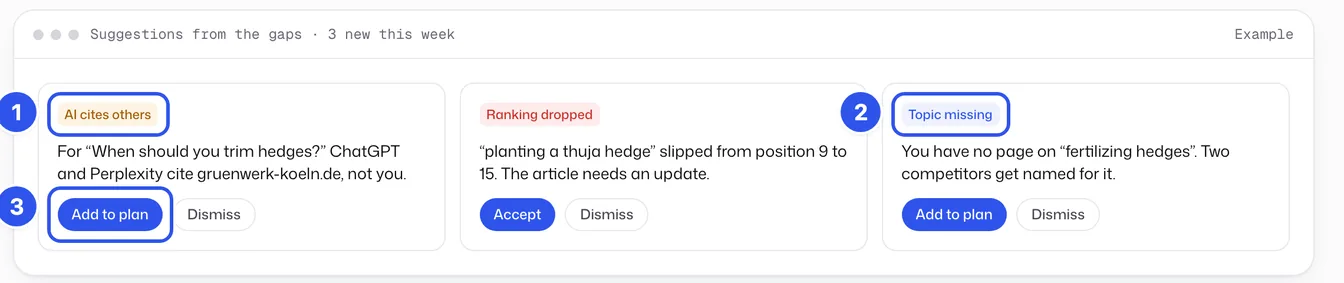
- "AI cites others": ChatGPT and Perplexity cite a competitor for a question you should own.
- "Topic missing": two competitors get named for a topic you have no page on.
- "Add to plan" turns the suggestion into a planned article.
Jobs: get measured, get chosen. Disclosure: this is our product. Citapult Visibility asks your customers' questions in five AI searches every week (ChatGPT, Google AI Overview, Google AI Mode, Perplexity and Gemini) and tracks your Google positions down to 100. Basic costs $59 per website a month for 25 prompts, 100 keywords, 3 competitors and 2 languages; Plus costs $119 for 50 prompts, 250 keywords and 5 competitors. A free check per account runs 10 prompts and 25 keywords once.
The difference from the trackers above is what happens to a gap. With Citapult Articles, an approved suggestion becomes an article written to the GEO rules AI answers reward: the answer right under the title, every number sourced in the same sentence, at least 3 distinct source domains, and JSON-LD with author and dates. The article agent then publishes to WordPress, Webflow, Next.js or a webhook. Articles Pro costs $99 per website a month for 30 articles; both together start at $158 (pricing).
Best for: small teams and agencies that want the gap closed, not only reported. Limit: weekly checks rather than daily, five engines (no Copilot or Claude), and prompt counts are lower than in tracking-only tools like SE Visible.
10. Scrunch: best for the AI agent side of search
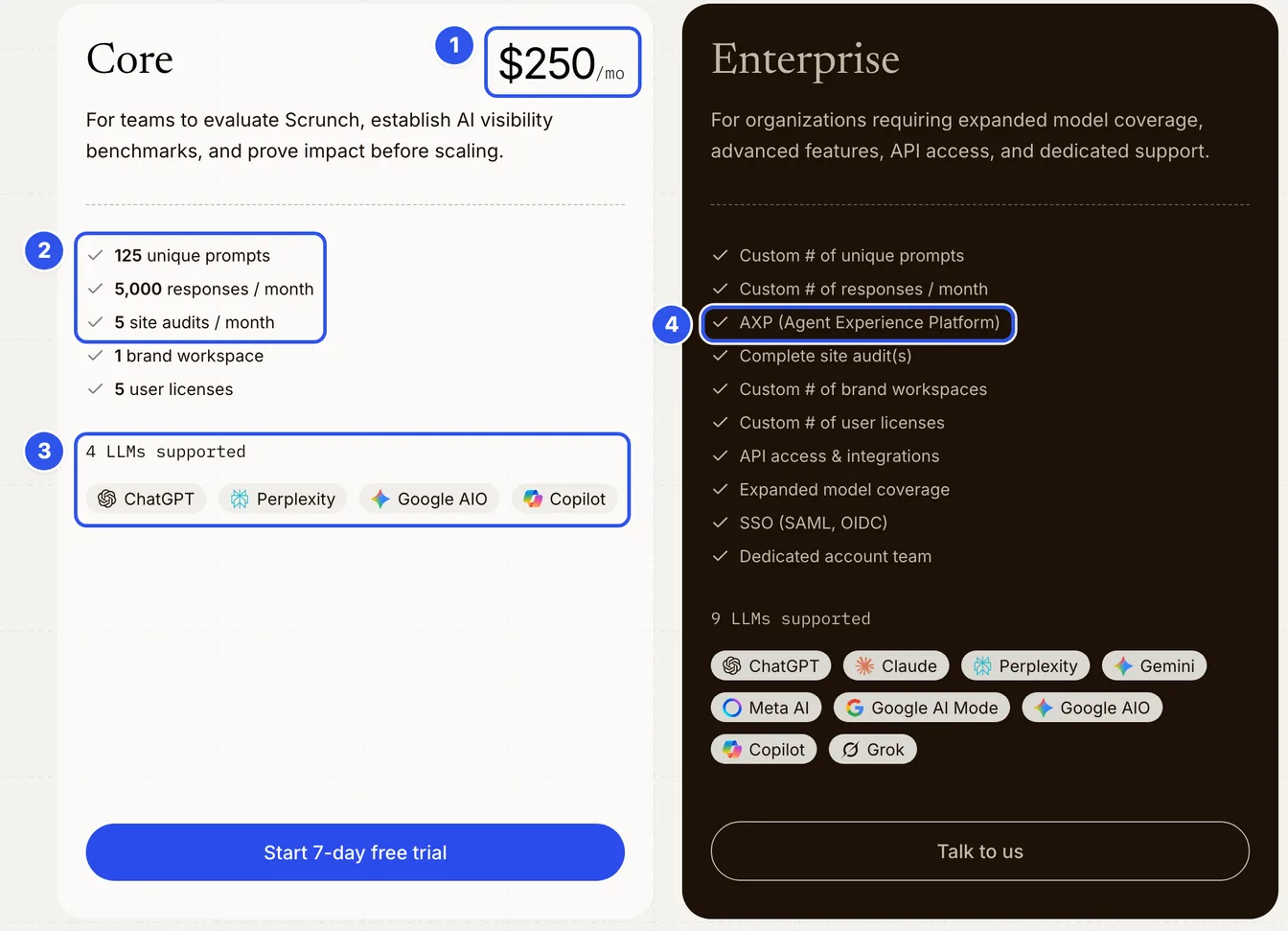
- Core at $250 a month.
- 125 unique prompts, 5,000 responses and 5 site audits a month.
- The 4 LLMs on Core: ChatGPT, Perplexity, Google AIO and Copilot.
- AXP (Agent Experience Platform), Scrunch's layer for serving AI agents, on Enterprise.
Jobs: all three, at a higher price. Scrunch Core includes 5 user licenses and a 7-day free trial. Enterprise expands to 9 LLMs (adding Claude, Gemini, Meta AI, Google AI Mode and Grok), API access, SSO and AXP. Beyond tracking, Scrunch sells agent traffic analytics and site optimization for how AI consumes your pages.
Best for: mid-size brands that care about AI agents visiting and reading their site, not only about answers. Limit: $250 is a steep entry point, and Gemini and AI Mode are Enterprise-only.
11. Profound: best for enterprise teams
Jobs: all three, at enterprise scale. Profound has a free trial that runs 50 prompts daily for 7 days on ChatGPT, Gemini and Google AI Overviews, with limited credits for its "AI Marketer" agent. After that it is Enterprise only, with custom pricing, up to 10 answer engines tracked, agents for recurring marketing work, SSO/SAML and SOC 2 compliance. The engine options include ChatGPT, Perplexity, Google AI Mode, Gemini, DeepSeek, Claude and Google AI Overviews.
Best for: large brands with a budget, a security review and a team to act on the data. Limit: no self-serve paid plan; you talk to sales.
Best generative engine optimization tools compared
| Tool | Main job | Entry price (checked Nov 12, 2026) | Engines at entry | Prompts at entry | Try first |
|---|---|---|---|---|---|
| Bing AI Performance | Measure (real citations) | Free | Copilot, Bing AI summaries, partners | Your actual citations | Free |
| Cloudflare AI Crawl Control | Get read | On all Cloudflare plans | AI crawlers | n/a | On all plans |
| Otterly.AI | Measure, audit | €29/mo | All 7 (prompt count assumes 3) | 20, daily | Free trial |
| Peec AI | Measure, act | €85/mo | 3 of your choice | 50, daily | Free trial |
| SE Visible | Measure | €80/mo (€64 yearly) | ChatGPT, AI Overviews, AI Mode, Gemini, Copilot | 75, daily | 10 days |
| Semrush AI Visibility | Measure, audit | $99/mo | Google AI Mode, ChatGPT and others | 25, daily | None |
| Ahrefs Brand Radar | Measure, benchmark | €47/mo custom prompts, €179/mo index | 6, plus Claude | Index of 558M | Prompts free on paid Ahrefs plans |
| Writesonic | Measure, write, audit | $79/mo (yearly) | ChatGPT, Gemini, AI Overviews | 50, daily | Start free |
| Citapult | Measure, write, publish | $59/mo per website | ChatGPT, AI Overview, AI Mode, Perplexity, Gemini | 25, weekly | Free check |
| Scrunch | Measure, audit, agents | $250/mo | ChatGPT, Perplexity, AIO, Copilot | 125 | 7 days |
| Profound | All, enterprise | Custom | Up to 10 | Custom | 7-day trial |
Which GEO tool should you pick?
- You have no budget: open Bing Webmaster Tools AI Performance and Search Console, and check AI Crawl Control if you are on Cloudflare. That covers jobs 1 and 2 with real data.
- You want daily numbers for under €50: Otterly.AI Lite.
- You are an agency with several clients: Peec AI (unlimited users) or SE Visible's Agency plan (1,000 prompts, 30 projects).
- You already pay for Semrush or Ahrefs: start with their add-on before buying a separate tracker.
- You want the gaps fixed, not only charted: Writesonic if you want tracking and drafts in one plan, Citapult if you want weekly suggestions turned into sourced, published articles.
- You are an enterprise brand: Profound or Scrunch, after a trial.
For a longer list of pure trackers, see our comparison of answer engine optimization tools, and for tools sorted by LLM rather than by job, our roundup of LLM SEO tools.
What to do once a tool finds a gap
A tracker tells you that a competitor gets cited for a question. Closing that gap is mostly content work:
- Check access first. Make sure robots.txt and your CDN let the AI crawlers in. Otterly, Peec and Semrush all include a crawler check; Cloudflare shows the actual bot traffic.
- Read the cited page. Peec and Otterly show which sources the engine used. Look at what that page answers that yours does not: a number, a table, a direct answer in the first lines.
- Write or update the page. Put the answer right under the heading, back numbers with sources, and cover the follow-up questions. Our guide on how to optimize content for AI search engines walks through it. This is the step Citapult automates: an approved gap becomes a sourced article, written by the article agent and published to your site.
- Measure again after a few weeks. AI answers change between runs, so compare trends over several checks, not single results.
FAQ
What are the best tools for generative engine optimization?
It depends on the job. For free, real citation data, use Bing Webmaster Tools AI Performance. For cheap daily tracking, Otterly.AI (€29 a month). For teams, Peec AI or SE Visible. For SEO suite users, the Semrush AI Visibility Toolkit ($99 a month) or Ahrefs Brand Radar. For tracking plus content, Writesonic or Citapult. For enterprise, Profound or Scrunch.
Are there free generative engine optimization tools?
Yes. Bing Webmaster Tools AI Performance and Google Search Console are free, and Cloudflare's AI Crawl Control is available on all Cloudflare plans. Several paid tools let you test first: Profound runs a free 7-day trial with 50 prompts, SE Visible offers 10 days, and Citapult runs one free check with 10 prompts.
Is SEO dead or evolving in 2026?
Evolving. Google says the best practices for SEO remain relevant for AI features such as AI Overviews and AI Mode, and that a page needs to be indexed and eligible to show with a snippet to appear as a supporting link. GEO builds on that foundation; it does not replace it.
Do I need an llms.txt file or special markup for GEO?
Not for Google. Google states that you don't need new machine-readable files, AI text files or special schema.org structured data to appear in AI Overviews or AI Mode. Be careful with tools that sell these as requirements.
What is the best agency for generative engine optimization?
We do not rank agencies here. If you would rather hire than buy software, compare what an agency delivers against these tools in our overview of generative engine optimization services. Ask any agency which tracking tool it uses, which engines it checks, and how it turns findings into content.
Sources
- 1arxiv.orgGEO: Generative Engine Optimization
- 2developers.google.comAI features and your website
- 3blogs.bing.comIntroducing AI Performance in Bing Webmaster Tools Public Preview
- 4developers.cloudflare.comAI Crawl Control
- 5otterly.aiPricing
- 6peec.aiPricing
- 7visible.seranking.comPricing & Plans
- 8semrush.comAI Visibility Toolkit
- 9ahrefs.comBrand Radar
- 10writesonic.comPricing
- 11citapult.comVisibility
- 12scrunch.comPricing
- 13tryprofound.comPricing
- 14support.google.comGenerative AI performance report (Search)