Generative Engine Optimization Services: 7 GEO Agencies Compared (2026)
7 generative engine optimization services compared on their live pages: published prices, timelines, how each measures AI visibility, and red flags to avoid.
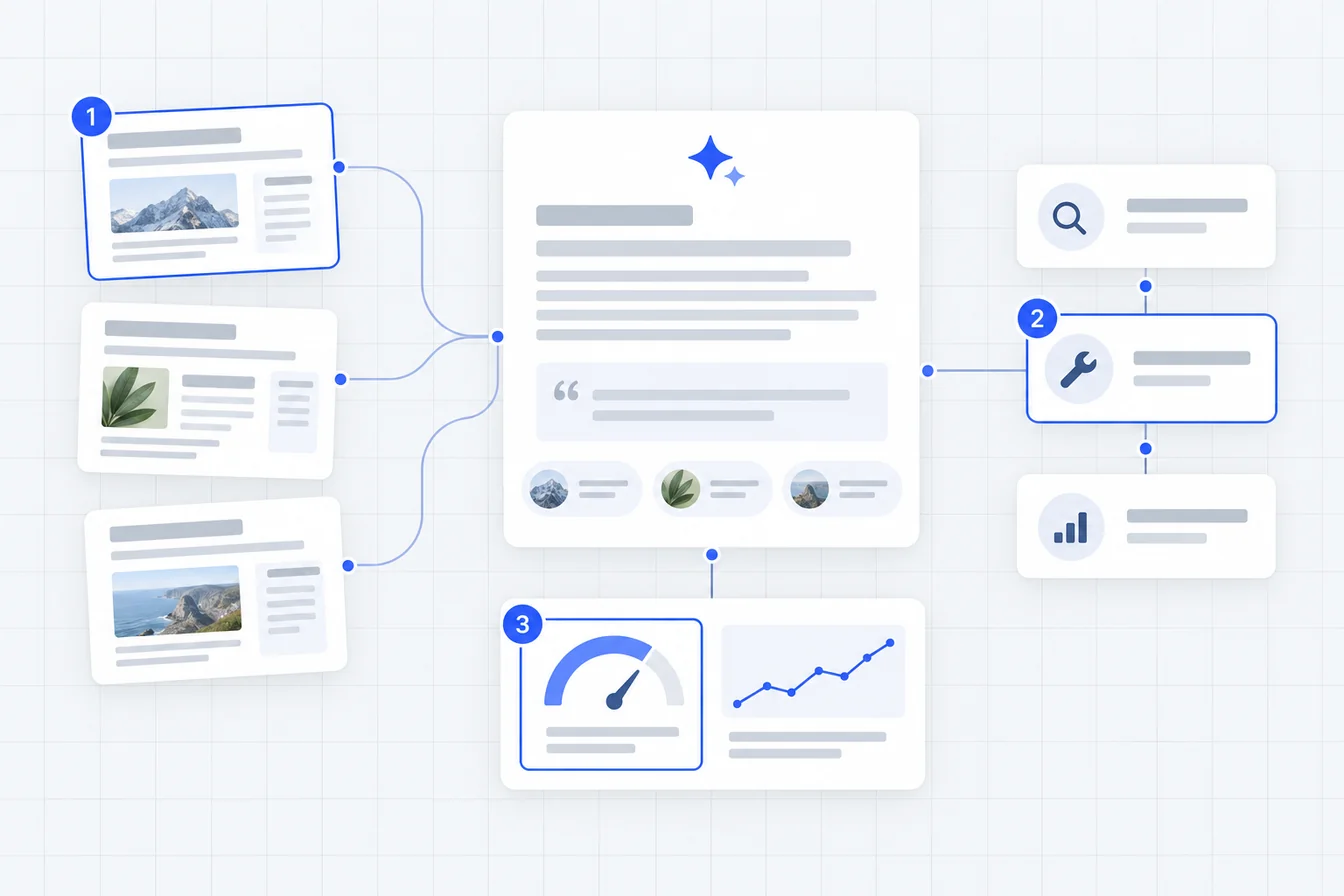
A generative engine optimization service is an agency program that tries to get your brand mentioned and cited in AI answers from ChatGPT, Perplexity, Gemini and Google's AI Overviews. The good ones audit where you appear today, build a set of buyer prompts, rework pages, earn mentions on other sites and track the results over months. Below are 7 GEO services from the current search results, compared on their live pages: what they deliver, what they publish about price and timelines, and which claims deserve a second look.
TL;DR
- Only one of the 7 publishes GEO prices: Percepture, from $3,500 to $10k+ a month. Everyone else quotes after an audit.
- Most programs share the same building blocks: an audit, a prompt set, content rewrites, schema, mention building and monthly tracking. The differences are in who does the work, how they measure, and what they promise.
- Google says optimizing for its AI features "is optimizing for the search experience, and thus still SEO." A GEO service that ignores SEO, or sells llms.txt files as the core fix, is a warning sign.
- Honest providers say measurement is sampled, not exact. Power Digital puts it plainly: "Anyone offering exact AI ranking positions is describing something that does not exist."
- If you have content people but no tracking, a visibility tool plus your own team can cover much of what an agency charges for. If you need digital PR and a hands-on team, hire.
A disclosure before the list: Citapult is software that tracks AI visibility and writes articles, not an agency, so it is not on this list. Where a step in a GEO service is something you can also do with a tool, we say so in the sections on measurement and on agency versus software.
What a generative engine optimization service includes
Strip away the branding and the 7 services below sell the same six building blocks. The names differ (Intero calls its framework "Intero GRO", Forthea sells "Knowledge Graph Engineering"), but the work underneath looks like this:
| Building block | What it means in practice | Who spells it out |
|---|---|---|
| AI visibility audit | Ask ChatGPT, Perplexity, Gemini and Google's AI features the questions your buyers ask, and record who gets named | All 7 |
| Prompt set | A fixed list of buyer questions that is checked again and again | Power Digital, OneMagnify, GreenBanana SEO, OrangeMantra |
| Content rework | Rewriting pages so they answer the question directly, with FAQ blocks and comparisons | All 7 |
| Technical and schema | Structured data, crawl access, entity markup | Percepture, Power Digital, GreenBanana SEO, Forthea, OrangeMantra |
| Mention and citation building | Digital PR, listings, community posts and third-party roundups | Percepture, Power Digital, GreenBanana SEO, Intero Digital, OrangeMantra |
| Tracking and reporting | Share of voice, citations and AI-referred traffic over time | All 7, with different tools |
Two things follow from that table. First, much of a GEO program is ordinary SEO and PR work aimed at a new kind of result page. OneMagnify's own FAQ says GEO "works best as an extension of a strong SEO program, not a replacement." Second, the parts that are new (the prompt set and the AI visibility tracking) are also the parts most open to overselling, because ChatGPT, Perplexity and Claude hand out no report like Search Console does.
If you want the background first, our guide to LLM SEO explains how AI answers pick their sources, and generative engine optimization vs SEO covers where the two overlap.
How we picked these GEO services
We ran two searches, "generative engine optimization service" and "generative engine optimization agency", and took the agencies whose own service page ranks on the first page. We left out the roundups: Go Fish Digital, Minuttia, SeoProfy and First Page Sage all publish "best GEO agencies" lists, and each one ranks its own agency first. Those lists are still useful for finding names, but they are not neutral.
Every fact below comes from the agency's own page, loaded on November 12, 2026. Where an agency publishes a claim we could not check (a conversion rate, a case-study result), we quote it as their claim and say so.
1. Percepture: the only GEO service with a public price list
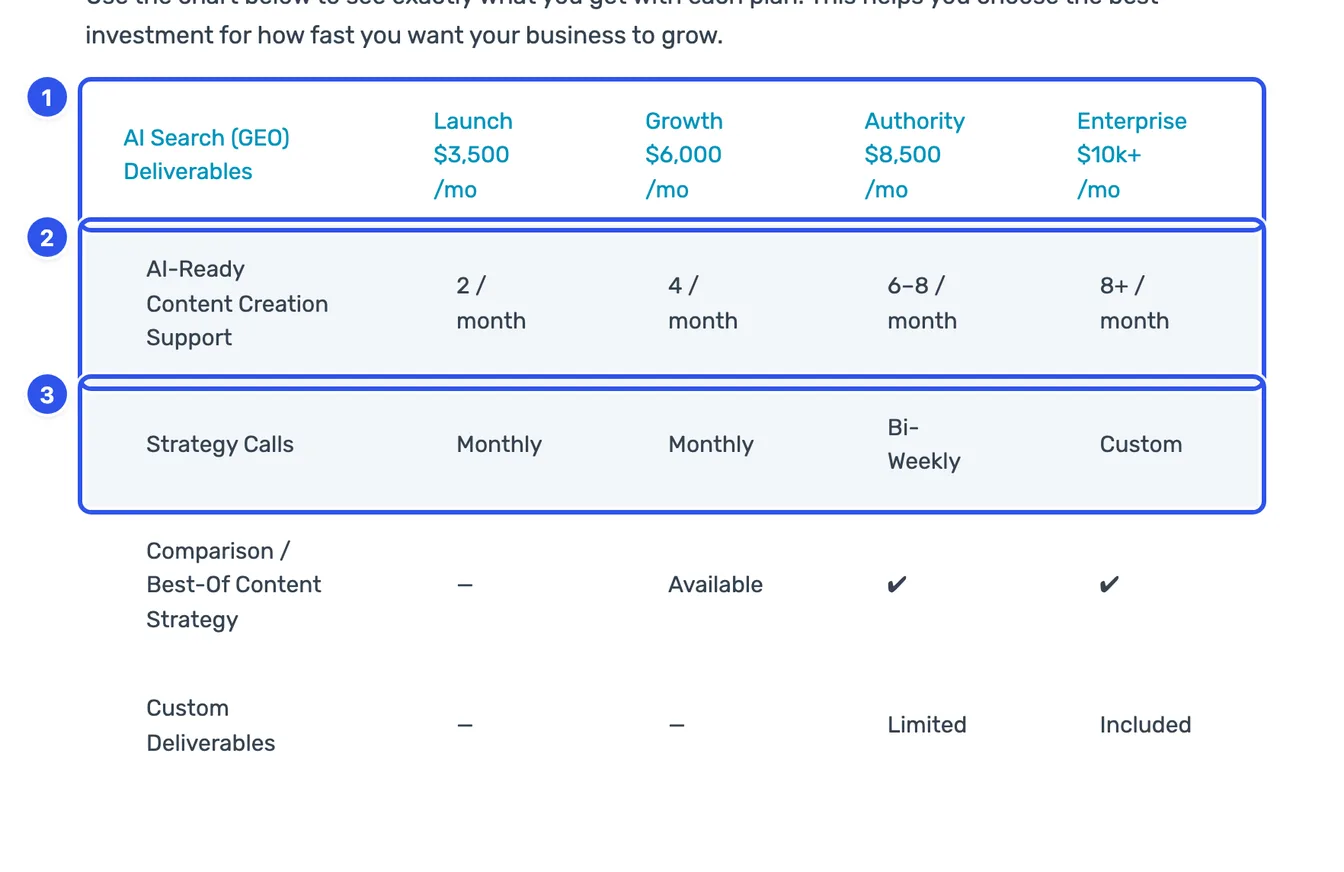
- Four packages: Launch at $3,500, Growth at $6,000, Authority at $8,500 and Enterprise at $10k+ per month. Growth is labeled "Most Popular".
- "AI-Ready Content Creation Support": 2, 4, 6 to 8, and 8+ pieces a month.
- Strategy calls are monthly on the two smaller plans and bi-weekly on Authority.
Percepture ranks first for both searches. Its GEO page describes a five-step workflow: intake and audit, a topic and entity map, page optimization with schema and FAQ formatting, digital PR for citations, and monthly measurement. It also builds "entity presence across Wikipedia, Wikidata, and structured databases." The agency says it was founded in 2004, and its address is in New York. On top of the packages, link and mention building costs +$1,000 to +$1,600 a month, and digital PR activation starts at $4,500 a month. For timing, the FAQ says "Most companies see initial results within 3-6 months, with some improvements appearing within 6 weeks."
The page also carries claims you should ask about before you sign. It says brands in AI answers "will have a" 27% conversion rate, attributed to "Backlinko's 2025 analysis" without a link. It quotes a client with "a 3000% increase in AI mentions in 3 months". And it predicts that "By 2027, 40% of all search queries will bypass traditional search results entirely", with no source given. None of that makes the service bad, but it is marketing, not evidence.
What to copy. Percepture's price table is the model for what you should demand from every other agency: monthly price, number of content pieces and call frequency, side by side. If an agency will not put those three numbers in writing, ask for them in the proposal.
2. Power Digital: the most honest page about measurement
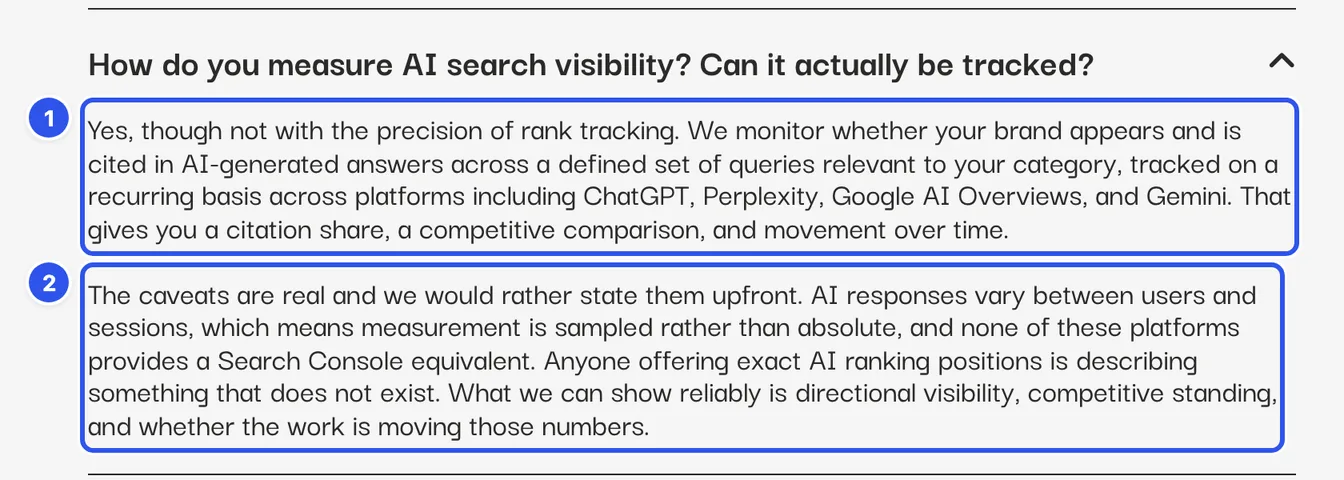
- How Power Digital tracks visibility: a defined set of queries, checked on a recurring basis across ChatGPT, Perplexity, Google AI Overviews and Gemini, reported as citation share against competitors.
- The caveats: answers vary between users and sessions, so "measurement is sampled rather than absolute." Of these platforms, only Google reports to you directly: Search Console shows impressions in AI Overviews, but not in ChatGPT, Perplexity or Gemini.
Power Digital sells six parts: an AI Readiness Audit, a Prompt & Theme Opportunity Audit, conversational content optimization, structured data and schema, authority and mention building, and AI visibility and citation share monitoring. A strategist leads the program "with technical SEO, content, and digital PR specialists supporting." The agency has offices in San Diego, New York, Medellín and Atlanta.
What sets the page apart is its FAQ. On cost, it says that for most brands GEO is scoped alongside SEO rather than sold as a separate line item, and adds: "If a provider is quoting GEO as a standalone premium service with no overlap acknowledged, it is worth asking what specifically is being done that SEO would not already cover." On timing, it says technical and structural changes can affect how AI systems retrieve your content "within weeks," with "the harder competitive queries taking a quarter or more." No price is published.
What to copy. Use Power Digital's own caveat as an interview question for every agency: "Which parts of this would my SEO program not already cover?" A vague answer tells you a lot.
3. OneMagnify: GEO tied to leads, with a written list of what it won't do
OneMagnify's GEO page is the only one in this group that lists its limits in a single sentence: "We don't guarantee citations, publish mass-produced AI content, use tactics designed to game AI platforms, or optimize just to raise a score in our own tool."
The process starts with competitors, growth priorities and the prompts your buyers use, and turns them into a roadmap ranked by impact and effort. Measurement runs on two tracks: a proprietary tool for share of voice, sentiment and mentions across a defined prompt set, and your own analytics for AI-referred visitors who fill in lead forms or buy. Quick wins "typically go live in month two." Your program is staffed by an "SEO and GEO director, manager, strategists, and specialists," with development support on request, and "nothing ships without your approval."
OneMagnify names ChatGPT, Claude, Gemini, Perplexity and Google AI Overviews and AI Mode as the platforms it works on. It also says it supports multi-site, multi-brand, international and multilingual programs and works within legal and compliance review. No price is published.
What to copy. Ask any agency to write down what it will not do. OneMagnify's sentence (no guaranteed citations, no mass-produced content, no gaming) is a good template for your contract.
4. GreenBanana SEO: the clearest 16-week plan
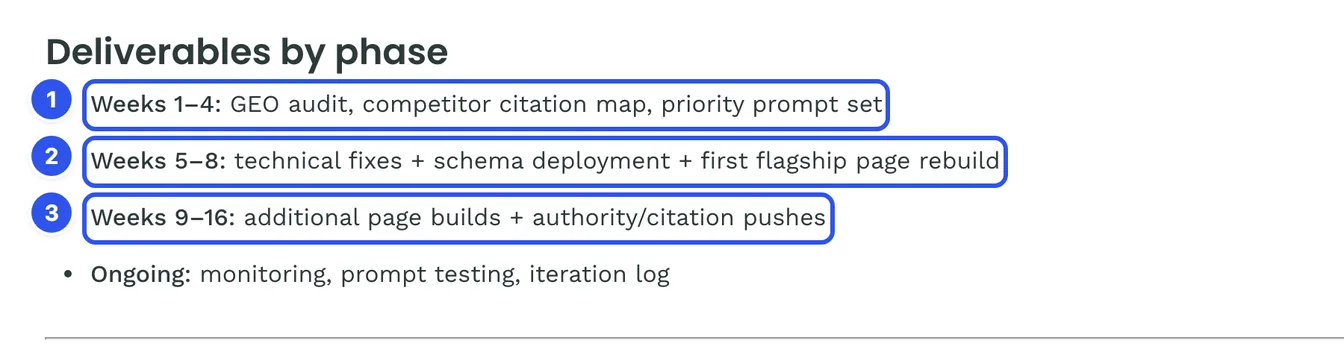
- Weeks 1 to 4: GEO audit, competitor citation map and a priority prompt set.
- Weeks 5 to 8: technical fixes, schema and the first rebuilt "flagship" page.
- Weeks 9 to 16: more page builds plus authority and citation pushes, followed by ongoing monitoring.
GreenBanana SEO has been "providing SEO (and now AEO/GEO) since 2009." Its deliverables are concrete: a 180-day roadmap with a priority prompt set, done-for-you page builds, and a GEO reporting dashboard with a monthly experiment log "documenting what we changed, what we tested, and what moved." The first 30 days cover a baseline snapshot, technical and entity fixes, and the first flagship page.
Pricing "depends on scope": the number of priority pages, the competitiveness of your market and how much citation work is needed. Most programs "start with an audit + roadmap, then move into monthly execution."
One item to discuss: the technical part of the service supports "AI access management using modern conventions like llms.txt." For Google Search, that file does nothing (see the vetting section below). It may matter for other systems, so ask what they expect it to achieve for you.
What to copy. The monthly experiment log. Whoever does your GEO work, in-house or agency, should write down each change and what moved afterwards. Without it you cannot tell a working tactic from noise.
5. Forthea: GEO with a revenue dashboard
Forthea packages its service into five offers: a GEO Discovery Audit across ChatGPT, Claude, Perplexity and Google AI, an AI-First Content Strategy, Knowledge Graph Engineering (content for buyer questions plus entity optimization), Competitive Intelligence for AI, and GEO Performance Intelligence. The last one is a proprietary dashboard that "links your AI visibility directly to leads, conversions, and revenue."
On timing, Forthea writes that "initial visibility improvements often appear within 60-90 days," while leads and conversions "typically build over 6 months." It lists two industry awards, SEO Performance + Results (Winner 2022) and SEO Agency of the Year (Finalist 2023), and a case study with GMN Bearing. No price is published.
What to copy. Forthea's split between "visibility improvements" and "business impact" is the right way to set expectations. Agree on both milestones, with separate dates, before the work starts.
6. Intero Digital: a five-phase framework with community work
Intero Digital runs GEO through a trademarked framework, "Intero GRO™ (Generative Response Optimization®)". It has five phases: an AI visibility audit, content ecosystem planning, a GEO strategy and road map, optimization and implementation, and tracking. Its page is the only one in this group that names community and forum activity on Reddit, Quora and LinkedIn as a visibility signal it works on. For tracking, Intero says tools like Profound track brand visibility across AI platforms.
The platform list is the longest of the 7: ChatGPT, Google AI Overviews, Google AI Mode, Gemini, Perplexity, Microsoft Copilot, Claude, Meta AI, xAI Grok, Bing AI-powered summaries and DuckDuckGo AI Chat. The page offers a free GEO audit and quotes Steven Elwell, Senior Director of Digital Marketing at Freshpet.
One inconsistency: the same page says "13,000+ Clients Served" in one block and "500+ Clients Served" in another. Ask which number refers to what. No price is published.
What to copy. If your buyers ask on Reddit or LinkedIn before they buy, community work belongs in your GEO plan. Intero is the only service here that says so explicitly.
7. OrangeMantra: the most specific case-study numbers
OrangeMantra, headquartered in Gurgaon, India, lists eleven GEO services, from audits to "LLM Training Data Visibility Optimization." What stands out are its case studies, each with a number:
- An electronics retailer: 120+ pages rewritten, mentions in 35+ technology publications, and a "38% AI citation rate, up from under 4%."
- An ecommerce brand: "517 AI Overview appearances" in 6 months, up from near zero.
- A B2B tech company: "AI visibility grew from 14% to 58%," tracked across 500+ prompts.
The timeline answer is specific too: "most clients see initial citations and mentions within 8 to 12 weeks," and "meaningful share of voice across multiple AI platforms usually builds over 4 to 6 months." The footer says the company is "Rated 4.8 out of 5.0 by 700+ clients on 600+ projects." No price is published.
These are the agency's own numbers about anonymous clients, so treat them as claims. They are still useful: they tell you which metrics to ask about (citation rate, AI Overview appearances, visibility across a prompt set) when you compare proposals.
What to copy. Ask every agency for one case study in the shape OrangeMantra uses: starting point, what was done, end result, and how many prompts were tracked.
GEO services compared
| Service | Published price | Timeline they state | How they measure | Worth asking about |
|---|---|---|---|---|
| Percepture | $3,500 to $10k+ per month | 3 to 6 months, some changes in 6 weeks | AI mentions, referral traffic, sentiment, monthly | Unsourced 27% conversion claim |
| Power Digital | Scoped, usually with SEO | Weeks for easy queries, a quarter or more for hard ones | Citation share on a recurring query set | Nothing; the page lists its own caveats |
| OneMagnify | Not published | Quick wins in month two | Own tool plus your analytics, through to leads | Which prompt set and competitors |
| GreenBanana SEO | Depends on scope | 16-week phase plan, 180-day roadmap | Dashboard plus monthly experiment log | Role of llms.txt in the plan |
| Forthea | Not published | 60 to 90 days for visibility, 6 months for leads | Proprietary revenue dashboard | How AI traffic is attributed |
| Intero Digital | Not published, free audit | Not stated | Profound and similar tools | 13,000+ vs 500+ clients |
| OrangeMantra | Not published | 8 to 12 weeks for first citations, 4 to 6 months for share of voice | Citation rate and visibility across prompt sets | Anonymous case studies |
What generative engine optimization services cost
Only Percepture publishes a GEO price list, so it is the one hard number in this market: $3,500 a month for the entry package, $6,000 for the most popular one, and $10k+ for enterprise, with mention building and digital PR on top. The other six price after an audit.
Power Digital's FAQ explains why many quotes are lower than they look at first: for most brands, GEO is scoped together with SEO because both rely on the same content, technical work and authority. If you already pay for SEO, the question to ask is what the GEO line adds. If an agency sells GEO as a separate premium package and cannot name the difference, you may be paying twice for the same pages.
For a budget check, compare three numbers across proposals: the monthly fee, the number of pages or content pieces per month, and the number of prompts tracked. Those are the parts that scale the work. Everything else (dashboards, calls, audits) is overhead around them.
How to vet a GEO agency before you sign
Google's own documentation is the best checklist here, because Google runs one of the AI answer systems these services target.
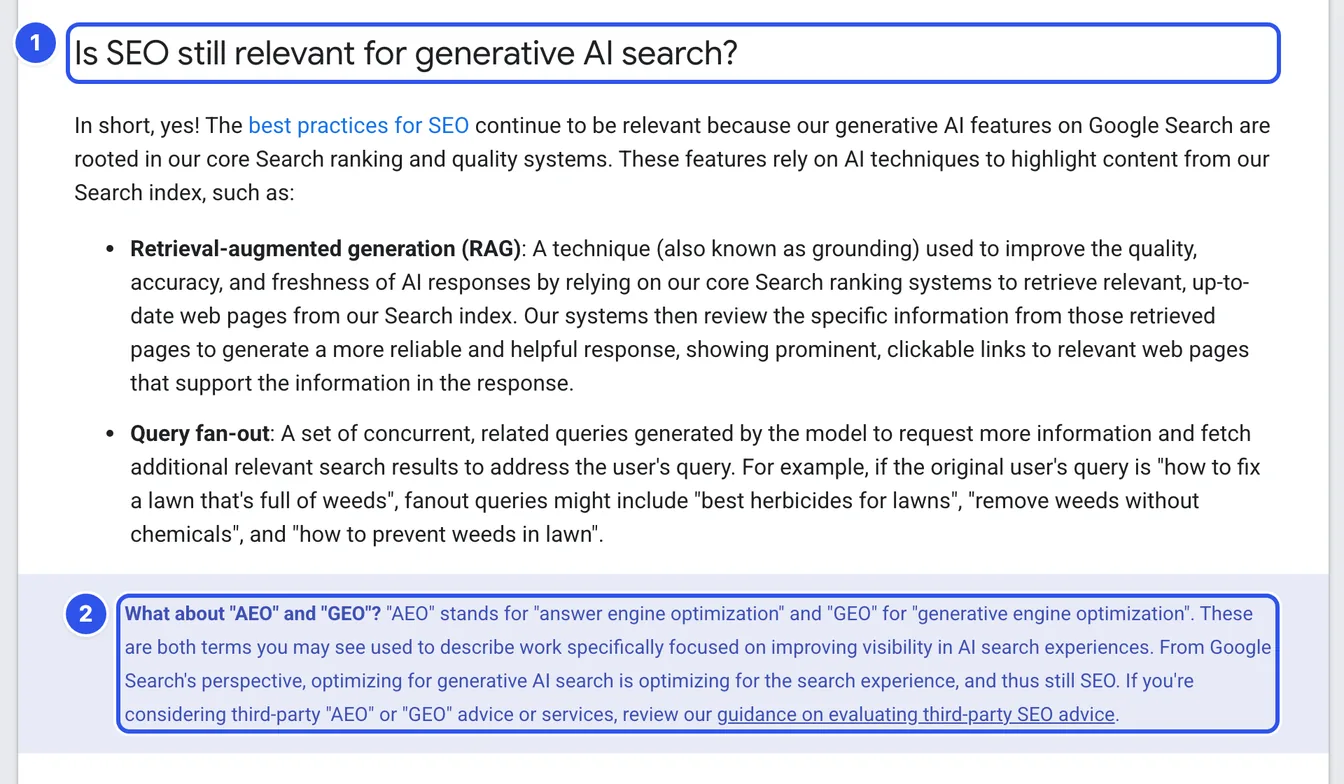
- The section that answers whether SEO still matters for AI search.
- The note on GEO services: "optimizing for generative AI search is optimizing for the search experience, and thus still SEO," with a pointer to Google's guidance on evaluating third-party SEO advice.
The same guide lists tactics you can ignore for Google Search:
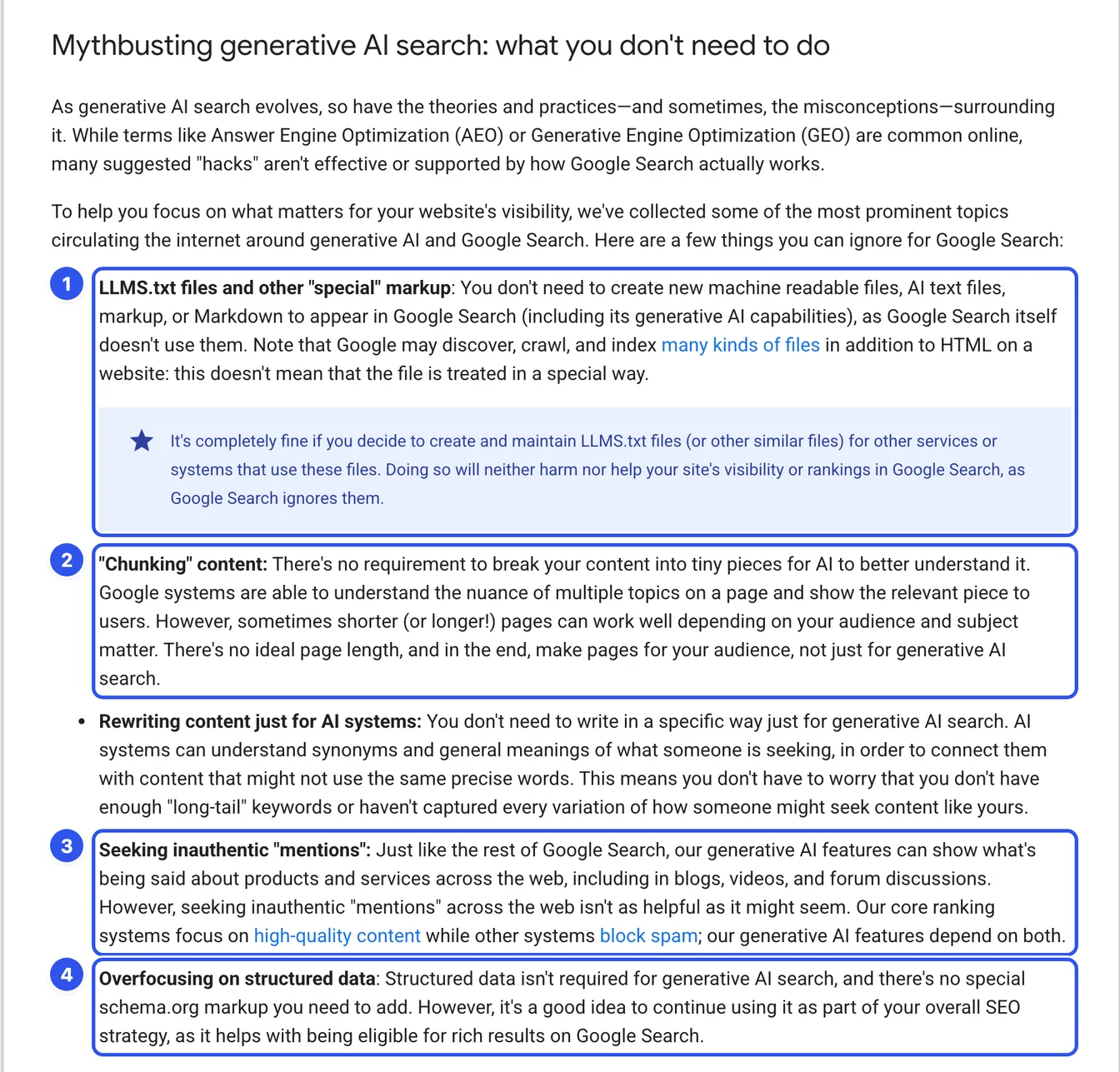
- LLMS.txt files and other "special" markup: Google Search ignores them.
- "Chunking" content into tiny pieces: not required.
- Seeking inauthentic "mentions": "isn't as helpful as it might seem."
- Overfocusing on structured data: "Structured data isn't required for generative AI search."
Google's separate page on AI features adds: "There are no additional requirements to appear in AI Overviews or AI Mode." The guide also warns that "No third-party tool has access to our internal ranking or AI systems," and Google's page on third-party SEO services says it does not evaluate them.
That gives you five checks for any GEO proposal:
- No guarantees. Google's advice on hiring an SEO says "No one can guarantee a #1 ranking on Google." The same applies to citations in AI answers. OneMagnify writes it into its page; a provider that promises citations is promising something it does not control.
- No llms.txt as the main fix. It may help with other systems, but for Google Search it does nothing. If it appears in the proposal, ask what it is for.
- Sources for every statistic. A conversion rate or traffic forecast without a link is a sales line. Ask for the source.
- Read access only during the audit. Google recommends granting only read access to Search Console at the audit stage, not write access.
- References and a defined prompt set. Interview the team, ask for examples of past work (Google's hiring guide suggests both), and make the agency name the prompts and competitors it will track before you sign.
How GEO services measure results, and what you can track yourself
Every service on this list sells monthly reporting, and every report is built the same way: a fixed set of prompts is asked again and again in several AI searches, and the answers are checked for your brand, your competitors and your links. Power Digital calls this sampled measurement, and that is the honest description. Answers change between sessions, so a single check means little; the trend over weeks is what counts.
That part does not need an agency. Citapult's AI visibility check asks your prompts every week in five AI searches (ChatGPT, Google AI Overview, Google AI Mode, Perplexity and Gemini), compares you with up to 3 competitors on Basic ($59 per website a month, 25 prompts), and adds your Google positions down to 100.
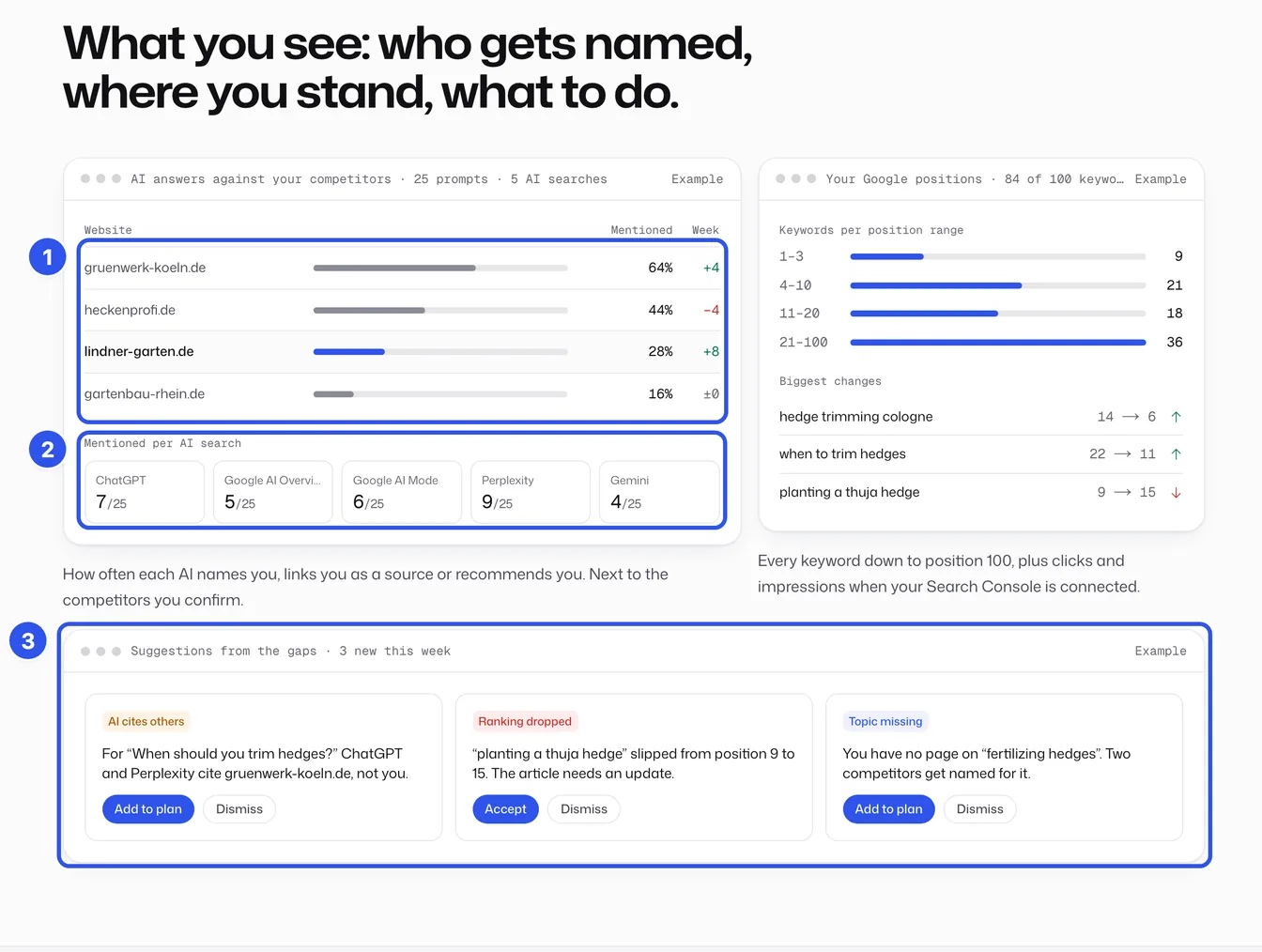
- How often each website gets named across the prompt set, with the change from last week.
- Mentions split by AI search, out of 25 prompts each.
- Suggestions from the gaps: where AI cites a competitor, where a ranking dropped, and which topic has no page yet.
Whether you hire an agency or not, a tracker like this gives you your own baseline before the agency's first report arrives. If you want to compare dedicated trackers, see our list of the best generative engine optimization tools and our guide to an AI Overviews tracker.
Agency, software or in-house: who should pick what
A GEO service is worth the money when you need things software cannot do: digital PR that lands your brand in publications, community work, entity cleanup across Wikipedia and Wikidata, and a team that rebuilds pages for you. It is harder to justify when your gap is mostly content: pages that do not answer the question directly, numbers without sources, no FAQ.
That content gap is what Citapult's GEO article writing handles: each article opens with a 2 to 3 sentence answer under the title, sources every number in the same sentence, uses at least 3 source domains and ships with JSON-LD. Visibility suggestions can turn into planned articles if you also use Articles.
- Pick Percepture if you want a fixed monthly price and digital PR from one vendor.
- Pick Power Digital if you already run SEO and want GEO scoped into it, not sold on top.
- Pick OneMagnify if you need approvals, compliance review or multilingual programs, and want results tied to leads.
- Pick GreenBanana SEO if you want a dated 16-week plan and done-for-you page builds.
- Pick Forthea if revenue attribution is the main thing your leadership will ask about.
- Pick Intero Digital if your buyers research on Reddit, Quora or LinkedIn.
- Pick OrangeMantra if you want an agency that reports in citation rates and prompt-set visibility.
- Do it in-house with a tracker if you have writers and an SEO lead, and mainly need to see where AI names your competitors instead of you.
If you are comparing these services with answer engine optimization offers, our overview of answer engine optimization services covers the agencies that sell under that label.
FAQ
Is generative engine optimization a thing?
Yes, as a name for a real practice, though not as a separate discipline from SEO. The term comes from a 2023 research paper by Pranjal Aggarwal and co-authors, presented at KDD 2024, which found that some content changes raised visibility in AI answers by up to 40%. Wikipedia notes there is still no consensus definition, and Google treats it as part of SEO.
How much does a generative engine optimization service cost?
Percepture is the only provider in this comparison with public GEO prices: $3,500 to $10k+ per month, with link building and digital PR extra. The others quote after an audit, and Power Digital notes that GEO is usually scoped together with SEO rather than as a separate line item.
Is SEO a thing anymore?
Yes. Google's AI optimization guide says optimizing for generative AI search "is optimizing for the search experience, and thus still SEO," and its AI features page says there are no additional requirements to appear in AI Overviews or AI Mode. Most GEO services in this list build on SEO work rather than replacing it.
How long does a GEO service take to show results?
The agencies' own estimates range from weeks to months: OneMagnify expects quick wins in month two, Forthea 60 to 90 days for visibility, OrangeMantra 8 to 12 weeks for first citations, and Percepture 3 to 6 months. Leads and share of voice usually take longer, around 4 to 6 months by OrangeMantra's and Forthea's estimates.
How do I find reviews of GEO companies?
Most "best GEO agencies" lists are written by agencies that put themselves first (Go Fish Digital, Minuttia, SeoProfy and First Page Sage all do). Read them for names, then check each agency's own service page, ask for references and case studies with a prompt count, and follow Google's advice on hiring an SEO.
Sources
- 1percepture.comGenerative Engine Optimization Services | GEO Agency
- 2percepture.comAI Search (GEO) Packages and Pricing
- 3powerdigitalmarketing.comGenerative Engine Optimization (GEO) Services
- 4onemagnify.comGenerative Engine Optimization (GEO) Agency Services
- 5greenbananaseo.comGenerative Engine Optimization Agency (GEO)
- 6forthea.comGEO | Generative Engine Optimization Agency
- 7interodigital.comGenerative Engine Optimization Services
- 8orangemantra.comGenerative Engine Optimization Services
- 9developers.google.comGoogle's Guide to Optimizing for Generative AI Features on Google Search
- 10developers.google.comAI Features and Your Website
- 11developers.google.comGoogle Search's Guidance on Third-Party SEO Tools & Advice
- 12developers.google.comDo You Need an SEO? Tips for Hiring an SEO
- 13en.wikipedia.orgGenerative engine optimization
- 14arxiv.orgGEO: Generative Engine Optimization
- 15gofishdigital.com8 Generative Engine Optimization (GEO) Agencies & Thought Leaders
- 16minuttia.com10 Best Generative Engine Optimization (GEO) Agencies 2026
- 17seoprofy.comTOP 13 Generative Engine Optimization (GEO) Agencies in 2026
- 18firstpagesage.comThe Top GEO Agencies of 2026
- 19support.google.comGenerative AI performance report (Search)