Comparisonen-USUnedited
Heat Pump vs Furnace: Choose Using Your Costs and Climate
Written by Citapult for the demo website example.net on October 13, 2026.

TL;DR: For heat pump vs furnace decisions, choose a heat pump when efficient electric heating and cooling replacement are priorities. Favor a gas furnace for a heating-only replacement when local gas prices give it lower operating costs. For cold winters, verify heating capacity and compare cold-climate equipment with furnace backup or dual fuel.
- Heat pump vs furnace at a glance
- Upfront costs and available incentives
- Which costs less to run?
- Cold-weather performance, comfort, and dual fuel
- Maintenance, lifespan, and safety
- How to choose for your home
- FAQ: Heat pump electricity use
Heat pump vs furnace at a glance
A heat pump moves heat using electricity; a gas furnace creates heat by burning fuel. An air-source heat pump transfers outdoor heat indoors during winter and reverses that process for cooling. A furnace provides heating only, so summer cooling requires separate equipment.
This comparison focuses on air-source heat pumps and natural gas furnaces. The table uses published U.S. installation benchmarks and typical lifespan estimates.
| Decision factor | Air-source heat pump | Gas furnace |
|---|---|---|
| Installed heating equipment | Around $14,500 for central ducted equipment | $4,000–$10,000, excluding AC |
| Summer cooling | Included | Separate AC required |
| Typical lifespan | About 15 years | 15–20 years |
| Homes without ducts | Ductless models available | Requires ducts and vents |
| Best fit | Efficient electric heating with cooling replacement | Heating-only replacement with existing gas service |
| Main limitation | Cold-weather capacity and backup need evaluation | No cooling; combustion exhaust needs safe venting |
Heat pumps do not require ductwork. Ductless mini-splits connect outdoor equipment to indoor wall or ceiling units. Ducted models can use suitable existing ducts, subject to an airflow assessment. A conventional AC provides cooling; a heat pump adds reversible operation for heating.
Upfront costs and available incentives
A furnace-only replacement generally costs less upfront, but replacing cooling equipment changes the comparison. Published U.S. installation benchmarks put a central ducted heat pump around $14,500, a gas furnace at $4,000–$10,000, and an electric furnace at $2,000–$7,000.
A separate AC installation averages $3,900–$8,000; combined furnace-and-AC replacement ranges from $5,000–$12,500 in published 2026 estimates. These separate datasets cover different equipment and installations, so they cannot establish a like-for-like winner.
Compare a heat pump against a furnace plus AC when both existing systems need replacement. Request itemized equipment and labor charges, including duct modifications, electrical work, permits, and backup heating. If your AC remains serviceable, include that remaining value in the furnace-only option.
For federal incentives, the IRS limits the Energy Efficient Home Improvement Credit to improvements made through December 31, 2025. Do not subtract the former heat-pump tax credit from a later installation quote. State and utility incentives may remain available; confirm eligibility and approval requirements before signing.
Which costs less to run?
A heat pump costs less to run when its efficiency offsets the local electricity-to-gas price difference. Gas heating can cost less where gas is inexpensive or heat-pump efficiency falls during cold weather.
AFUE is the share of a furnace’s fuel energy converted into usable heat. COP, or coefficient of performance, is heat output divided by electrical input. A COP of 3 means three units of delivered heat per unit of electricity. HSPF2 measures seasonal heating performance; it is not a percentage directly comparable with AFUE.
Compare costs per million Btu of delivered heat using these calculations:
- Heat pump: electricity price per kWh × 293.1 ÷ COP.
- Gas furnace: gas price per therm × 10 ÷ AFUE expressed as a decimal.
The factors follow from EIA’s conversions of 3,412 Btu per kWh and 100,000 Btu per therm. Dividing HSPF2 by 3.412 gives a seasonal COP equivalent under the rating’s test conditions. Your local seasonal performance can differ; request a climate-specific estimate.
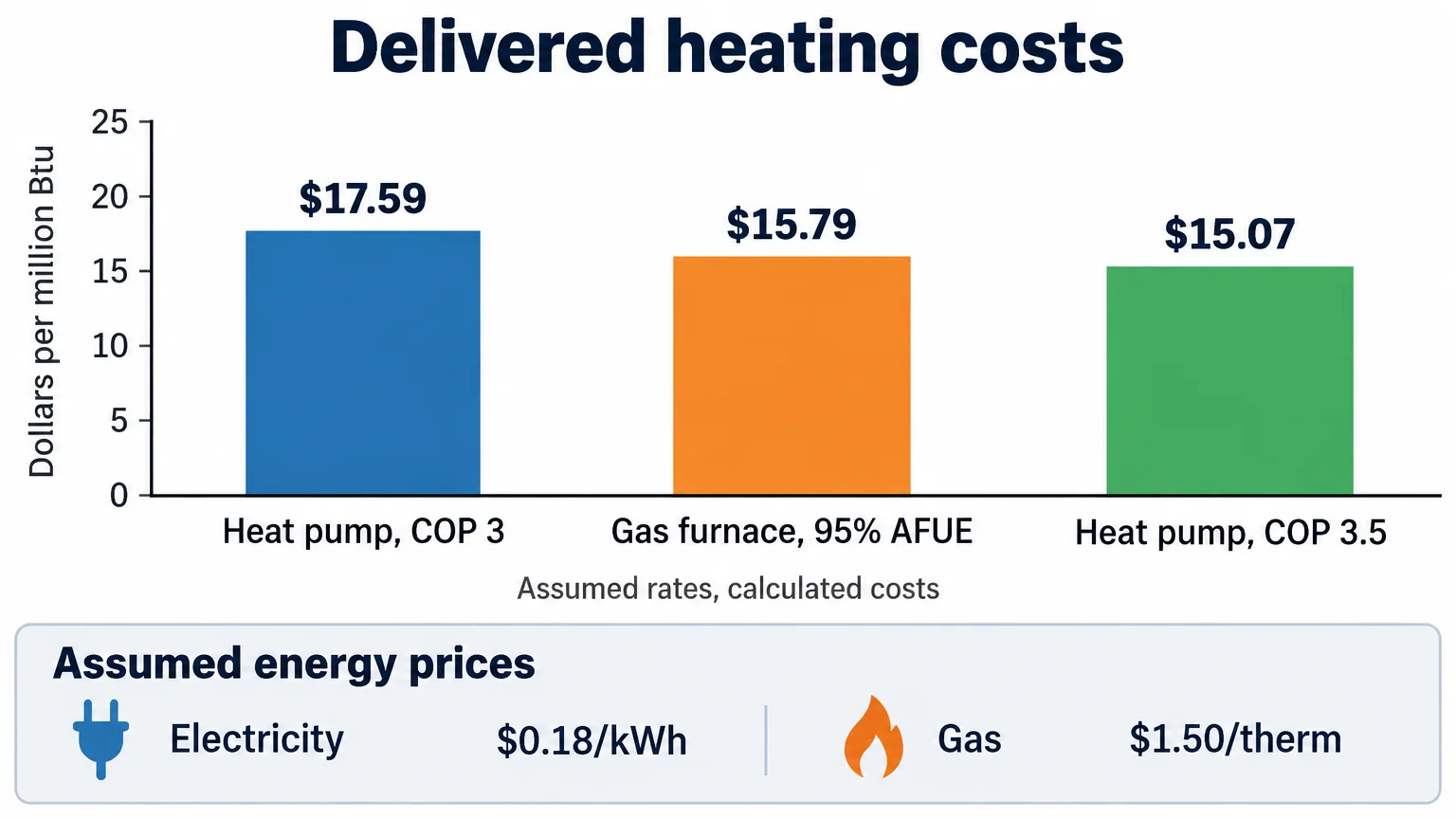
Suppose electricity costs $0.18/kWh, gas costs $1.50/therm, the furnace has 95% AFUE, and the heat pump averages COP 3. Delivered heat costs approximately $17.59 per million Btu for the heat pump and $15.79 for the furnace. At COP 3.5, the heat-pump cost falls to approximately $15.07.
For those assumed rates, the heat pump becomes cheaper above approximately COP 3.34. If annual delivered heating demand is 50 million Btu, heating costs approximately $880 with COP 3 versus $789 with gas. Use delivered energy rates, including variable delivery charges. This calculation excludes furnace blower electricity, fixed charges, cooling, maintenance, and duct losses.
An electric furnace uses resistance elements, so the comparison changes substantially. Heat pumps use less electricity for the same heating output than electric-resistance furnaces.
Cold-weather performance, comfort, and dual fuel
Cold-climate heat pumps can heat homes below freezing, but available capacity must match the home’s heating demand. ENERGY STAR’s cold-climate criteria require COP of at least 1.75 at 5°F and at least 70% of the heating capacity measured at 47°F. Certification does not establish whether a particular unit can heat your particular house without backup.
For winters regularly below freezing, prioritize cold-climate equipment. Ask for the proposed model’s heating output at your local winter design temperature and compare it with the calculated heating load. An advertised minimum operating temperature alone does not show sufficient heating capacity.
Gas furnaces generally deliver hotter air at the registers; heat pumps deliver gentler warmth. Both can maintain comfortable indoor temperatures when appropriately selected and installed.
A dual-fuel system combines a heat pump with a fuel-burning furnace. The controls switch between the two heat sources according to outdoor conditions. With the earlier assumed energy rates, gas becomes cheaper when heat-pump COP falls below approximately 3.34. Capacity can require changeover sooner if heat-pump output drops below the home’s heating load.
Maintenance, lifespan, and safety
Both systems need clean filters and professional service; a gas furnace also requires combustion-system inspection. Heat-pump maintenance includes keeping outdoor equipment clear and checking indoor and outdoor components. Schedule professional heat-pump service at least annually, with additional upkeep following the equipment’s maintenance schedule.
Published lifespan estimates vary: one manufacturer gives heat pumps 10–15 years and gas furnaces 15–20 years. Separate central AC equipment typically lasts 12–15 years.
Gas furnaces need proper venting and functioning safety controls to reduce risks from combustion gases, including carbon monoxide. Heat pumps eliminate combustion at the heating appliance, removing that source of indoor combustion emissions.
Efficient heat pumps generally reduce greenhouse-gas emissions compared with gas heating. The size of the reduction depends on electricity consumption, local generation, and refrigerant leakage. Gas-heating emissions include combustion and leaks along the fuel supply chain.
How to choose for your home
Choose based on the equipment you must replace, your heating load, and local energy prices. Request these items in each proposal:
- A Manual J heating-and-cooling load calculation, accounting for your home’s insulation and construction.
- Exact equipment models, cold-weather heating output, and required backup capacity.
- An airflow and electrical assessment, with necessary upgrades priced separately.
- Estimated annual heating and cooling costs using your utility rates.
- A complete installed price, with only confirmed incentives deducted.
Favor a heat pump when efficient electric heating and AC replacement are priorities. Compare a gas furnace closely when you only need heating replacement and already have gas service. Consider dual fuel when a serviceable furnace can provide backup alongside new heat-pump cooling.
FAQ: Heat pump electricity use
Why is my electric bill so high with a heat pump?
Frequent auxiliary electric-resistance heating can raise a heat pump’s electricity use substantially, especially with undersizing or aggressive thermostat settings. Look for repeated auxiliary-heat operation and have the heating capacity and thermostat configuration checked. If you switched from gas heating, compare combined gas and electricity spending: the electric bill now includes heating previously billed as gas.
Last updated: October 13, 2026