Best AI SEO Agencies in 2026: 8 Firms Compared (With Real Prices)
8 AI SEO agencies compared on their live pages: published prices from $3,000/month to $120,000/year, commitments, AI visibility tracking and red flags to avoid.
The best AI SEO agency depends on your size and budget: Seer Interactive, iPullRank and Siege Media lead for enterprise and SaaS brands, Omniscient Digital for B2B software, and WebFX or Coalition Technologies for companies that want a published monthly price. Below are 8 AI SEO agencies compared on what their own service pages say today, with the prices they publish, the commitment they ask for and how they measure AI visibility. We also show the questions Google tells you to ask before you hire anyone, and which parts of the work you can do without an agency.
TL;DR
- Published prices for dedicated AI SEO services start at $3,000 a month (WebFX) and go to $120,000 a year and up (Omniscient Digital). WebFX's own estimate for agency GEO work is $1,500 to $50,000+ a month.
- The strongest agencies are the ones that admit what nobody knows yet. iPullRank and Seer both say on their GEO pages that no one has the answer figured out.
- Google says optimizing for its AI features "is still SEO" and lists LLMS.txt files, chunking and rewriting content for AI as things you can ignore. An agency that sells those as the core of its service is a red flag.
- Ask for a 6 month horizon at minimum. Siege Media says outright that it is not a fit if you need results in weeks.
- If you mainly need content and tracking, software covers a lot of it for far less than an agency retainer. Save the agency budget for digital PR, strategy and technical work.
How we picked these AI SEO agencies
Search for "best AI SEO agencies" and nearly every result is a list written by an agency, usually with the author's own firm at the top. There is a reason for that. First Page Sage, one of the agencies below, writes on its GEO page that "appearing in highly-ranked list articles is the largest factor impacting which companies or products are recommended by chatbots." Agencies publish these lists because the lists themselves are a GEO tactic.
This list is different in one respect: we are not an agency and none of the firms below is ours. Citapult makes software for SEO articles and AI visibility tracking, which we mention where it is relevant in the section on agency versus software. To build the shortlist we read nine agency roundups that rank for this keyword and kept the firms that showed up across several of them. iPullRank and Omniscient Digital appeared in five, Seer Interactive and Siege Media in four, Go Fish Digital in three. We added Coalition Technologies because it ranks first on Google for "ai seo agency", and WebFX because it publishes a full price table for its GEO service.
Then we checked each agency on its live service page, against four criteria:
- Honesty about uncertainty. Does the agency admit that AI search is still changing, or does it promise guaranteed citations?
- Measurement. How does it track visibility in ChatGPT, Perplexity, Gemini and Google's AI Overviews, and does it connect that to leads or revenue?
- Published pricing and commitment. Can you see a price or a minimum term before the first call?
- Fit with Google's guidance. Google's own documentation now covers AI features and lists the tactics that do not matter for them. We checked whether each agency's pitch matches it.
Every price, number and quote below comes from the agency's page as it reads in November 2026. Agencies change their pages often, so check again before you sign.
1. iPullRank: best for brands that want to build GEO in-house
iPullRank calls its approach "Relevance Engineering" and describes itself as human-led and AI-powered. Its GEO page is the most candid one we read: "No one has fully figured out GEO yet. Anyone who tells you otherwise is selling you certainty that doesn't exist right now."
What you get depends on your stage. The page splits clients into emerging brands, mid-market and challenger brands with some internal resources, and Fortune 500s and category leaders with several lines of business. For the larger groups it lists an AI search measurement framework, cross-platform visibility measurement and content engineering. iPullRank also offers to help you build an internal GEO program "so you can execute in-house as your business grows," which is unusual for an agency.
The homepage claims "$5B+ in organic search results" for clients and a place on the Inc. 5000 list. iPullRank publishes a free AI Search Manual, which is a good way to judge its thinking before you talk to sales. No price is published.
Pick iPullRank if you are a mid-size or large brand with an in-house team and want a partner who teaches the method, not just one who runs it.
2. Seer Interactive: best for enterprises that want a test-first start
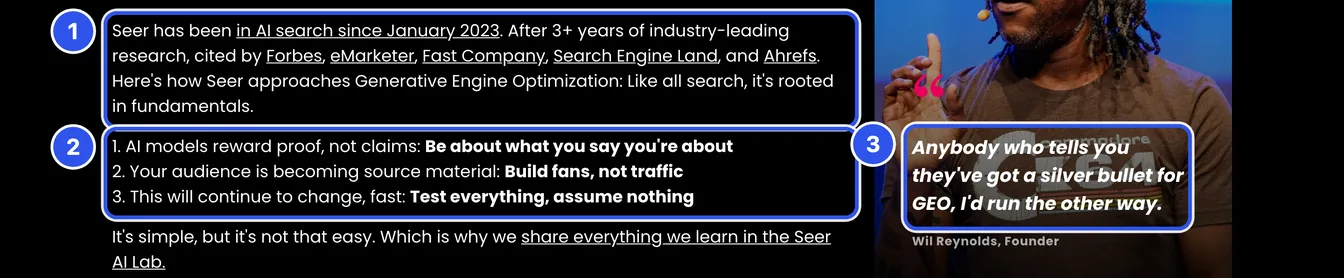
- Seer says it has been "in AI search since January 2023" and grounds its approach in search fundamentals.
- Three principles, the last of which is "Test everything, assume nothing."
- Founder Wil Reynolds: "Anybody who tells you they've got a silver bullet for GEO, I'd run the other way."
Seer publishes its own research on what AI answers cite. In one study across 4,124 pages cited in LLM answers, 72% had been updated in the past year but only 42% had been published in the past year, which argues for refreshing pages you already have before you write new ones. Seer also warns buyers directly: "If an agency is showing you AI visibility gains built on scaled listicle content, ask them what happens when the models start penalizing it."
You do not need to sign up for a year. The page says "You don't need to commit to a 12-month program to get answers" and describes a diagnostic phase as the usual start. Tracking runs through a partnership with Scrunch, so you get tool access without buying another platform. Seer reports 130+ enterprise clients and a 92% retention rate, and says that since January 2025, 15% of its own inbound conversions came from people who found it in an LLM. No price is published.
Pick Seer if you are an enterprise brand that wants evidence before a big commitment.
3. Siege Media: best for SaaS and ecommerce brands with a PR appetite
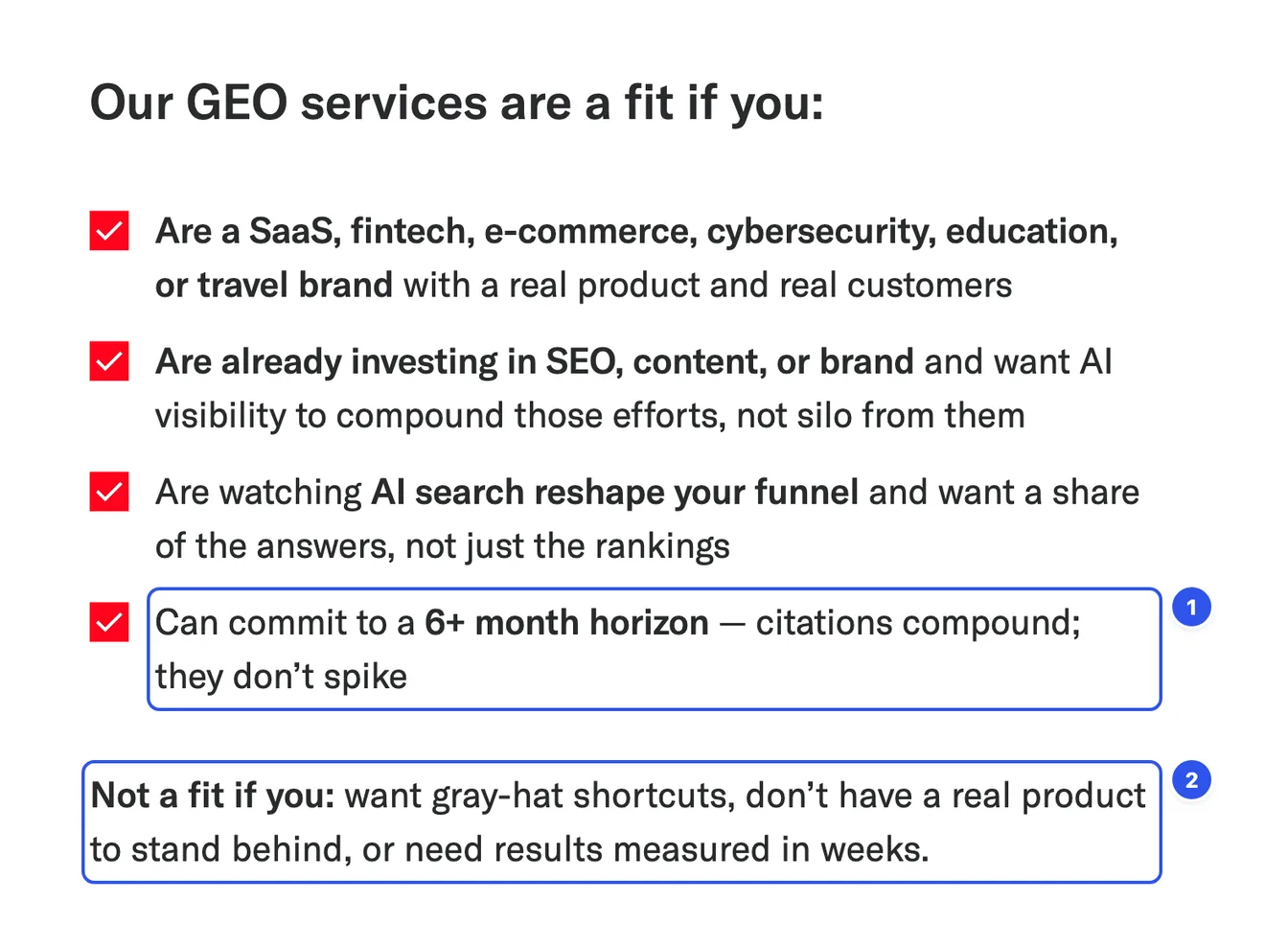
- Siege asks clients to commit to "a 6+ month horizon" because citations compound rather than spike.
- The "Not a fit if you" line rules out gray-hat shortcuts, brands without a real product and anyone who needs "results measured in weeks."
Siege Media treats GEO as placement work across every surface AI models cite: research reports and digital PR, bottom-funnel content, Reddit and affiliate partnerships. It backs the approach with its own data. Companies publishing original data, it says, "earn 45% more AI citations than peers running traditional formats," and in its portfolio study pricing-style content gained +12.1 points of traffic share while how-to content fell 88%. The agency cites 13 years of publisher relationships.
Every engagement includes monthly tracking of LLM share of voice in your category prompts, citations earned and AI referral traffic. Founder Ross Hudgens has written a book on the topic, Generative Engine Optimization, published by Wiley. The fit list names SaaS, fintech, ecommerce, cybersecurity, education and travel brands. No price is published.
Pick Siege if you sell software or products online and are ready to fund original research and digital PR, not just on-page edits.
4. Omniscient Digital: best for B2B software companies

- One of the few published prices among premium agencies: "Full-service engagements start at $120,000/year."
Omniscient Digital works only with B2B software companies and calls the service answer engine optimization (AEO). Its case studies are specific: Convert grew LLM visibility 81% and AI citations 140%, and Smartling grew organic traffic 56% with 352 new page 1 rankings. A quote on the page from Eric Hann, SVP of Go-to-Market at Order.co, says LLM traffic converts "at 30% versus 5% for traditional SEO."
One detail we liked: Omniscient sets aside part of every program for structured experiments, from citation studies to on-page tests of content structure and answer formats, because "AEO is evolving too quickly for static best practices."
Pick Omniscient if you are a B2B SaaS company with a six-figure organic budget and want content strategy and AEO from the same team.
5. WebFX: best for transparent, tiered pricing
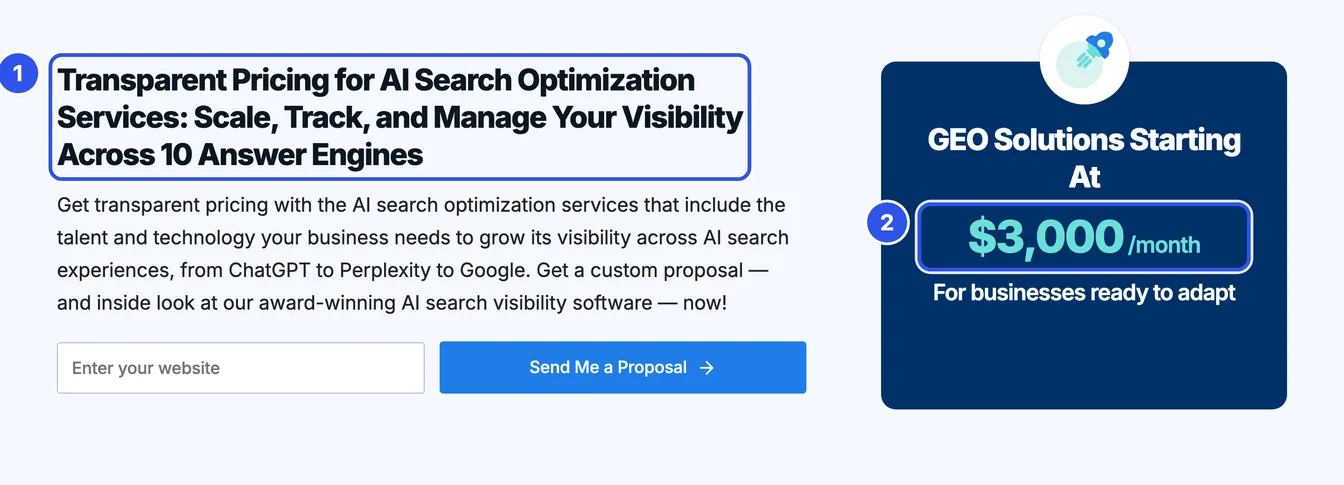
- WebFX tracks visibility across "10 Answer Engines," including ChatGPT, Perplexity, Gemini, Copilot, DeepSeek and Claude.
- GEO solutions start at $3,000 a month.
WebFX is the only agency here that publishes a full price table. Eight tiers run from Bronze at $3,000 a month through $5,250, $7,500, $12,000, $23,250, $34,500 and $68,250, with Global Enterprise+ priced by quote. Each tier comes with a 6-month commitment. What changes between tiers is mostly scale: tracked placements start at 500 (50 prompts across 10 LLMs) and go up to 50,000 (5000 prompts).
Tracking runs on WebFX's own software, OmniSEO. The agency says it has driven 12,335 leads for clients from AI sources and shows a 4.9/5 rating based on over 550 third-party reviews.
Pick WebFX if you want to see the price before the sales call and need a mid-market budget with clear deliverables.
6. First Page Sage: best for getting onto list articles
First Page Sage says its GEO service "was launched on May 9, 2023, making it the first ever GEO service offering," and the firm has over 15 years of SEO experience. Its method has six elements, led by list creation and optimization, since it considers ranking in highly ranked list articles the largest factor in what chatbots recommend. The other elements include database inclusion and reviews.
That focus is honest about how AI answers get built, and it is also the reason so many agency lists exist. If you hire First Page Sage, expect a large part of the work to be getting your brand onto third-party lists. No price is shown on the GEO page.
Pick First Page Sage if your buyers ask chatbots "what is the best X" and your brand is missing from the lists those answers draw on.
7. Go Fish Digital: best for technical and semantic content work
Go Fish Digital's GEO service is the most technical in this list. It starts with semantic content audits that map your whole site, then optimizes at page and passage level and scores content "using vector-based similarity to AI-generated answers." Technical work covers schema, IndexNow and sitemap coverage, plus internal linking and site hierarchy. A digital PR team works on brand citations, and the page stresses top rankings, since LLMs often pull from high-ranking pages.
The page argues the case with "over 58% of U.S. searches ending in zero clicks." No price is published.
Pick Go Fish Digital if your site is large and you suspect technical or structural problems are keeping your content out of AI answers.
8. Coalition Technologies: best for local and ecommerce budgets
Coalition Technologies ranks first on Google for "ai seo agency" and is itself a secondary search term ("ai seo company coalition"). Its AI SEO page claims "up to 1,750% growth in AI search sessions." The same page lists 800+ client case studies at the top, "500+ SEO case studies" in a stats bar and "860+ case studies" further down, so treat the headline numbers as marketing.
Its SEO pricing page is more useful. Coalition publishes average monthly prices by campaign type: $1,000 for neighborhood or suburb-focused local SEO, $2,000 for metro local, $2,900 for B2B, $3,800 for ecommerce, $4,200 for regulated industries and $4,700 for restricted industries. Coalition argues against fixed SEO packages and prices by scope instead.
Pick Coalition if you are a local business or an ecommerce store and want SEO and AI SEO from one retainer at a known average price.
AI SEO agencies compared
| Agency | Best for | Published price | Commitment | How it tracks AI visibility |
|---|---|---|---|---|
| iPullRank | Mid-market and Fortune 500 brands building in-house skills | Not published | Not stated | AI search measurement framework, cross-platform measurement |
| Seer Interactive | Enterprises that want a diagnostic first | Not published | No 12-month program needed to start | Scrunch partnership, tool access included |
| Siege Media | SaaS, fintech and ecommerce brands | Not published | 6+ months | Monthly LLM share of voice, citations, AI referrals |
| Omniscient Digital | B2B software companies | From $120,000/year | Annual engagements | LLM visibility and citations in case studies |
| WebFX | Mid-market buyers who want a price table | $3,000 to $68,250/month, then by quote | 6 months | OmniSEO, 500 to 50,000 tracked placements |
| First Page Sage | Getting onto third-party list articles | Not on GEO page | Not stated | Not detailed on GEO page |
| Go Fish Digital | Large sites with technical issues | Not published | Not stated | Vector similarity scoring against AI answers |
| Coalition Technologies | Local businesses and ecommerce | SEO averages from $1,000 to $4,700/month | Retainer | Not detailed on pricing page |
What AI SEO services cost
AI SEO packages vary more in scope than in name. WebFX's own cost guide puts generative engine optimization at "$10 to $1,000+ per month for DIY tools" and "$1,500 to $50,000+ per month for agency services." The published prices above fit that range: WebFX's tiers start at $3,000 a month, Coalition's SEO campaigns average $1,000 to $4,700 a month, and Omniscient starts at $120,000 a year, or $10,000 a month.
Business.com's guide to hiring an AI SEO agency adds the cheap end: entry-level AI visibility tools "generally run from roughly $30 to a few hundred dollars a month." It also notes that AEO, GEO, LLMO and "AI SEO" are used more or less interchangeably, with no standard definition separating them. So compare what a proposal contains, not what it is called.
How to vet an AI SEO company
Google updated its page on hiring an SEO with questions aimed at exactly these services.
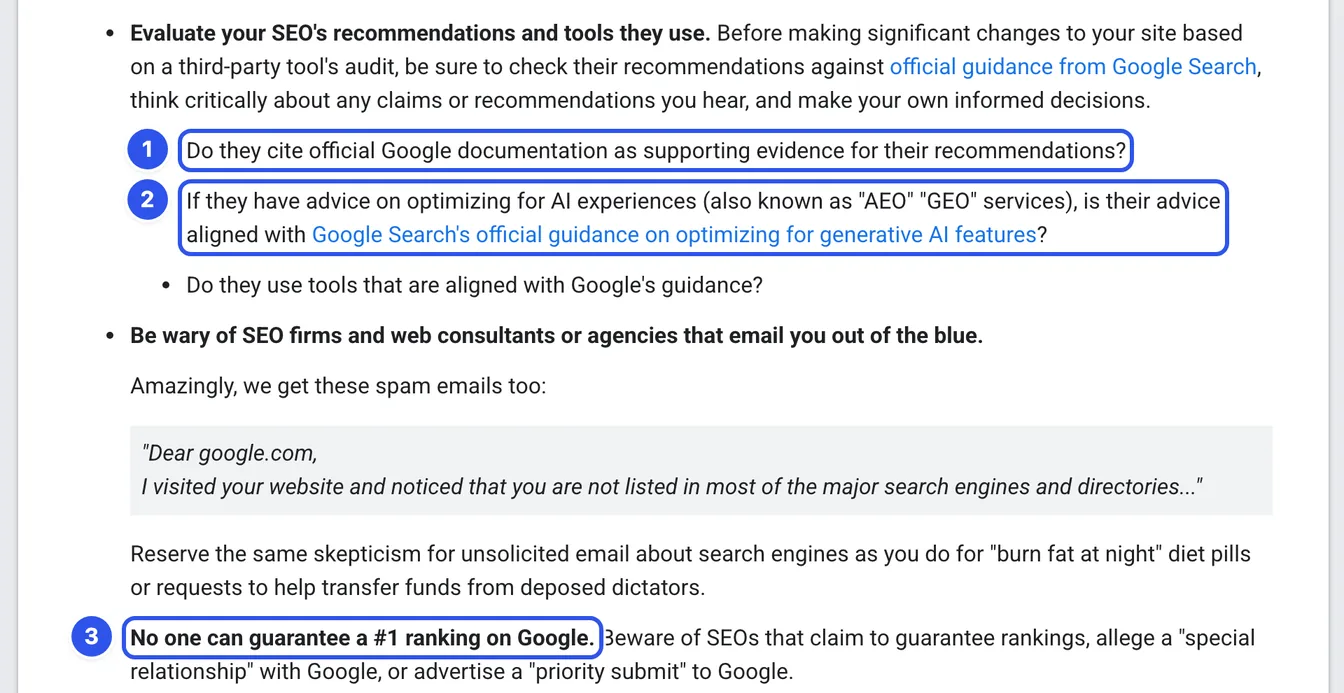
- Ask whether they cite official Google documentation as evidence for their recommendations.
- If they sell advice on optimizing for AI experiences ("AEO" or "GEO" services), ask whether it is aligned with Google's official guidance on generative AI features.
- "No one can guarantee a #1 ranking on Google." The same applies to AI citations.
Google's guide to optimizing for generative AI features is blunt: "From Google Search's perspective, optimizing for generative AI search is optimizing for the search experience, and thus still SEO." Its AI features page adds that there are "no additional requirements to appear in AI Overviews or AI Mode." The guide then lists popular tactics you can ignore for Google Search.
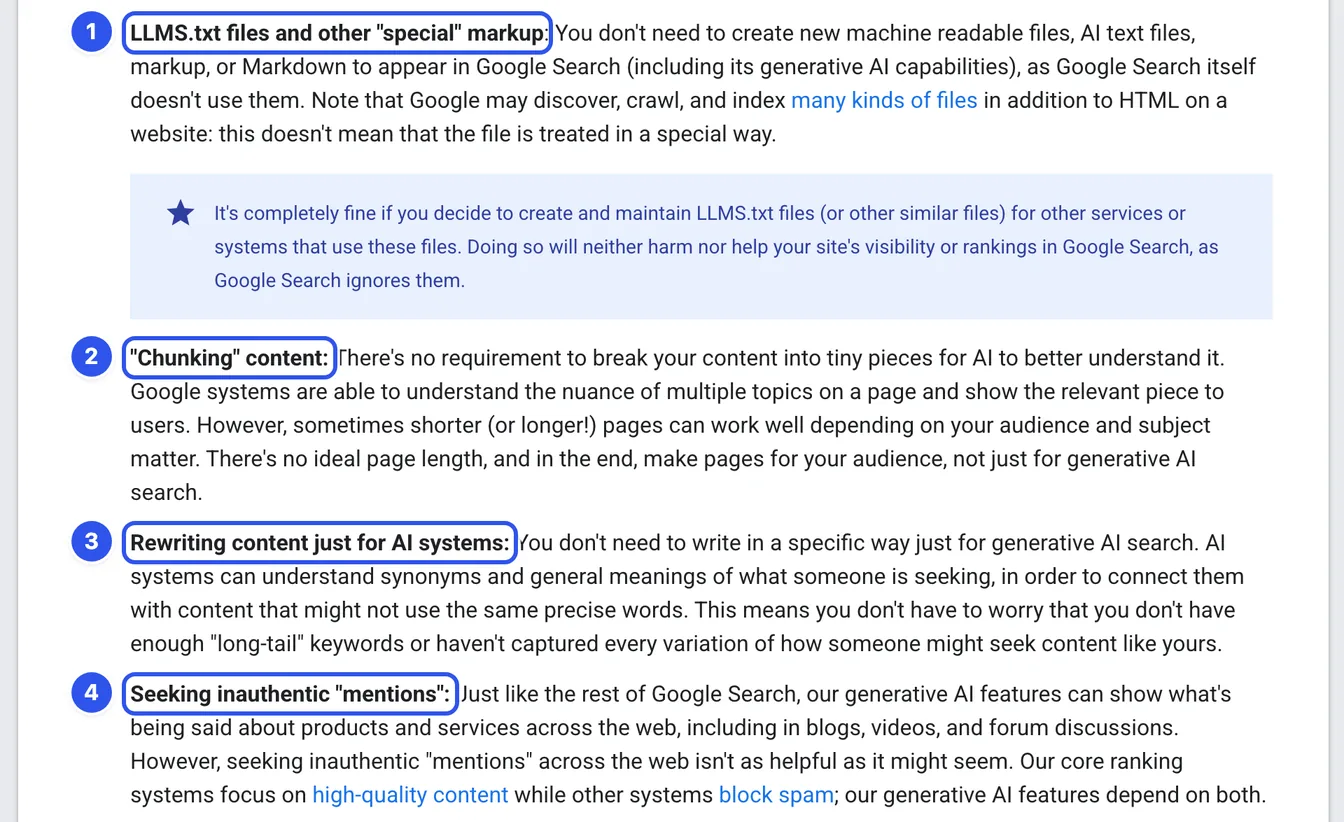
- LLMS.txt files and other "special" markup: Google Search does not use them.
- "Chunking" content into tiny pieces for AI is not required.
- Rewriting content just for AI systems is not needed, because AI systems understand synonyms.
- Seeking inauthentic "mentions" across the web is less helpful than it seems.
Google speaks only for Google, though. As Business.com points out, ChatGPT, Claude and Perplexity do not use Google's index and have published no equivalent guidance. A good agency says which advice applies to which engine.
Red flags to watch for:
- Guaranteed rankings or guaranteed citations. Google warns against anyone who promises a top spot, and AI answers change even more from one query to the next.
- A pitch built on llms.txt, chunking or "AI rewrites." Google lists all three as things you can ignore.
- Hundreds of near-identical pages. Google says creating many variant pages to manipulate rankings or AI responses violates its scaled content abuse policy. Seer warns about scaled listicle content for the same reason.
- Reports that stop at impressions. Business.com calls out "reporting that never reaches a business outcome." Ask how share of voice connects to leads or revenue.
- Write access to Search Console during an audit. Google advises granting read access only at that stage.
Agency or software: what you can do yourself
Before you pay for AI SEO services, set a baseline for free. Google's Search Console has a generative AI performance report, and as of August 31, 2026 it is rolled out to all websites worldwide. It shows your impressions from AI features over time and which pages get them. Business.com also suggests running a handful of real buying questions through ChatGPT, Gemini, Claude and Perplexity yourself, repeating each prompt a few times because answers vary, and segmenting ChatGPT referrals in analytics through the utm_source=chatgpt.com parameter. If you want to know how AI SEO differs from traditional SEO first, start there.
Much of what agencies sell splits into three jobs, and two of them can run on software:
- Tracking. Checking every week whether ChatGPT and Google's AI answers mention you is repeatable work. Citapult Visibility asks your customers' questions in ChatGPT, Google AI Overviews, Google AI Mode, Perplexity and Gemini every week and checks your Google positions down to 100. Basic costs $59 per website a month (25 prompts, 3 competitors), Plus $119 (50 prompts, 5 competitors), and there is one free check per account.
- Content. Seer's data says AI answers favor recently updated pages, and Siege's says pricing and comparison pages gain. Producing sourced articles at that pace is where software saves the most. The Citapult article agent reads the top 10 results, the questions Google shows and the AI Overview for each keyword, asks you four questions only you can answer, and sources every number it uses. With the Search Console connection, it flags articles that start falling and prepares a revision.
- Strategy, PR and technical fixes. Original research, publisher relationships, Reddit and list placements are where Siege, First Page Sage and Go Fish earn their fees. This is the part worth paying an agency for.
If you run an agency yourself and want to offer AI SEO services to clients, Citapult has a setup for agencies: unlimited client sites in one account, each with its own brief, and Pro articles carry no Citapult credit. For a wider view of the tool side, see our guide to the best AI SEO tools and how SEO automation fits around them.
Who should pick which AI SEO agency
- Enterprise brand, cautious about spend: Seer Interactive. Start with the diagnostic phase, no 12-month program needed.
- Mid-size or large brand with an in-house team: iPullRank. It will help you build your own GEO program.
- SaaS, fintech or ecommerce brand ready to fund PR and research: Siege Media, if you can wait 6+ months.
- B2B software company with a six-figure budget: Omniscient Digital, from $120,000 a year.
- Mid-market company that wants a fixed price: WebFX, from $3,000 a month on a 6-month commitment.
- Brand missing from "best X" lists: First Page Sage.
- Large site with technical debt: Go Fish Digital.
- Local business or ecommerce store: Coalition Technologies, with SEO averages from $1,000 a month.
- Small business with a tight budget: start with Search Console's generative AI report and a tracking tool, and hire later. Google itself notes that many small local businesses can do much of the work themselves. If you want one expert instead of a firm, an AI SEO consultant can be a middle path.
FAQ
Which AI SEO agency is the best?
There is no single best AI SEO agency. For enterprise brands, Seer Interactive and iPullRank stand out for their research and their honesty about what is still unknown. Siege Media fits SaaS and ecommerce brands that want PR-driven citations, and Omniscient Digital fits B2B software. For a published price, WebFX starts at $3,000 a month.
How much does AI SEO cost?
WebFX estimates $1,500 to $50,000+ a month for agency GEO services and $10 to $1,000+ a month for DIY tools. Published agency prices in this list range from $1,000 a month (Coalition's average for local SEO, not a dedicated AI package) to $120,000 a year (Omniscient Digital). Dedicated AI SEO packages start at $3,000 a month (WebFX). AI visibility tracking tools start at roughly $30 a month according to Business.com.
Is SEO dead or evolving in 2026?
Evolving. Google says optimizing for its AI features "is still SEO" and that there are no additional requirements to appear in AI Overviews or AI Mode. What has changed is where you need to be visible: in AI answers from ChatGPT, Perplexity and Gemini as well as in the ranking results, and that adds tracking, list placements and fresh, sourced content to the work.
What do AI SEO services include?
Most AI SEO services combine tracking of brand mentions in AI answers, content created or updated to be cited, technical work such as schema and crawlability, and digital PR or list placements on third-party sites. Siege Media, for example, bundles research reports, bottom-funnel content, Reddit and affiliate partnerships, while WebFX tiers its service by the number of tracked prompts.
Which AI agent is best for SEO?
That depends on the job. Agencies use AI agents for research, content and tracking, and you can use the same kind of tools in-house. Our guide to SEO AI agents compares the options.
Sources
- 1developers.google.comDo You Need an SEO? Tips for Hiring an SEO
- 2developers.google.comGoogle's Guide to Optimizing for Generative AI Features on Google Search
- 3developers.google.comAI Features and Your Website
- 4support.google.comGenerative AI performance report (Search)
- 5business.comShould You Hire an AI SEO Agency?
- 6ipullrank.comGenerative Engine Optimization (GEO) Services
- 7ipullrank.comHomepage
- 8seerinteractive.comGenerative Engine Optimization
- 9siegemedia.comGenerative Engine Optimization (GEO) Services
- 10beomniscient.comAnswer Engine Optimization (AEO) Services
- 11webfx.comAI Search Optimization Services & GEO Services
- 12webfx.comGEO Cost: How Much Does Generative Engine Optimization Cost?
- 13firstpagesage.comGenerative Engine Optimization (GEO) Services
- 14gofishdigital.comGenerative Engine Optimization (GEO) Services
- 15coalitiontechnologies.comBest AI SEO Agency for ChatGPT & AI Overviews
- 16coalitiontechnologies.comSEO Agency Pricing