SEO Writer AI: 10 Tools Compared on Price, Output and Publishing
10 SEO writer AI tools compared on price, articles per month, research and publishing: SEOWriting.ai, Frase, Surfer, Jasper, Citapult and more. Nov 2026.

An SEO writer AI is a tool that turns a keyword into a draft built to rank: it looks at what already ranks on Google, plans headings and length from that, writes the article and often adds images, links and a way to publish. The tools differ less in the language model they use than in what happens around it: how much research goes in before writing, how many articles you get for the money, and whether the result lands on your site or in a text box. We compared 10 of them on their live pricing and product pages.
TL;DR
- Cheapest volume: SEOWriting.ai Starter costs $14 a month on yearly billing for up to 50 articles, and Junia AI Growth $17 a month (yearly) for 10. SEOWriting.ai also gives you 3 free articles without a card.
- Writing plus optimization in one editor: Frase ($39 a month yearly, 10 articles) and Surfer (from €49 a month yearly in our region) score drafts against the pages that rank.
- Already paying for Semrush or a marketing team on Jasper? Semrush's Content Toolkit ($60 a month, 5 SEO-boosted articles) and Jasper Pro ($59 a seat yearly) are the shortest path.
- Research before writing and publishing included: Citapult reads the top 10 results, asks you four expert questions and sources every number. It costs $99 a month per website for 30 articles, with a $1 three-day trial.
- Whatever you pick, Google ranks the page, not the tool. Mass-produced pages without added value fall under its scaled content abuse policy.
What an SEO writer AI does, and what Google says about it
"SEO writer AI" covers four kinds of tools that solve different parts of the job:
- One-click article generators (SEOWriting.ai, Koala AI, Junia AI): you enter a keyword or title, they research the results page, write a full article and can post it to WordPress in bulk.
- Optimizers with a writer attached (Surfer, Frase, Clearscope): they grade a draft against the pages that rank, with a content score and term suggestions. The AI writer is one feature next to the editor.
- Marketing suites (Jasper, Semrush Content Toolkit): broad content platforms with brand voice and team features, where SEO articles are one use case.
- General chatbots (ChatGPT, Claude, Gemini): flexible and cheap, but they only know what you put into the prompt unless you add research yourself.
A comment in a Reddit thread on this exact question put it well: "by choosing a tool, you are choosing their prompting" (r/seogrowth). The model behind most of these tools is the same handful of models from OpenAI, Anthropic and Google. What you pay for is the workflow: the research, the brief, the checks and the publishing.
Google's position has not changed since its guidance on AI-generated content from February 8, 2023: its systems reward "high-quality content, however it is produced." Using automation, including AI, mainly to manipulate rankings is spam; using it to make helpful content is not.
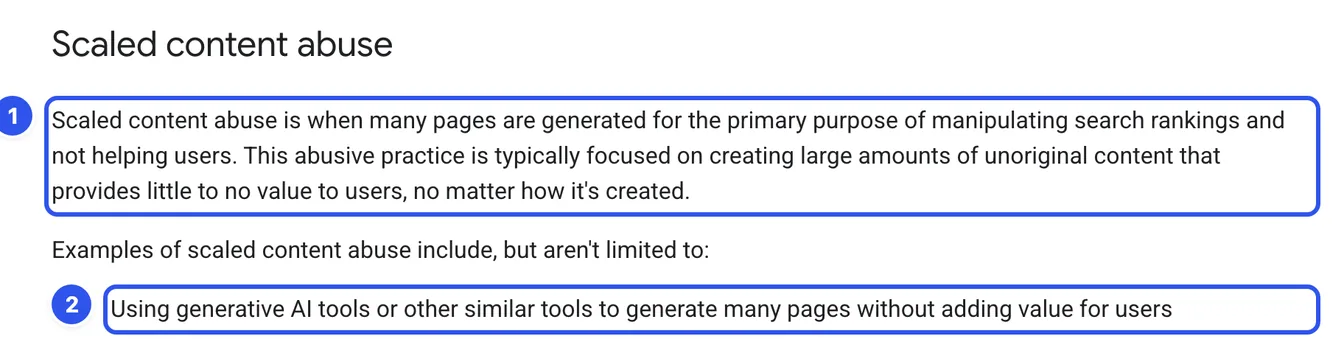
- The definition: many pages generated "for the primary purpose of manipulating search rankings and not helping users," no matter how they are created.
- The first example Google lists: using generative AI tools to generate many pages without adding value for users.
That second line is the practical test for any tool on this list. Bulk generation is a feature on most of them, and it is exactly what Google describes when the pages add nothing new. Google's helpful content guidelines ask whether a page provides "original information, reporting, research, or analysis" and "substantial value when compared to other pages in search results." For the bigger picture of where AI fits in an SEO workflow, see our guide to SEO automation.
How we compared the tools
We read each tool's live pricing and product pages on November 12, 2026 and compared them on five questions:
- Price of entry: what does the smallest paid plan cost, and is it billed monthly or yearly?
- Output: how many articles (or words, or documents) does that price buy?
- Research: does the tool analyze the results page before writing, or only after?
- Publishing: can it post to your CMS, and which ones?
- Trial: can you test it without paying?
Some vendors showed euro prices because of our location, and US readers may see dollars. Prices can exclude tax. Citapult is our own product. We list it with the same kind of facts as the others, taken from its public pages, and say where another tool fits better.
1. SEOWriting.ai: the most articles per dollar

- The page opens on yearly billing, which saves 25%.
- Starter at $14 a month, billed $168 a year.
- Up to 50 articles a month at that price.
SEOWriting.ai is the top organic result for "seo writer ai" and built for volume. You give it a title, it analyzes the competitors in the search results and writes the article, in one of 50+ languages, with generated images. Bulk generation can auto-post up to 100 articles in a batch to WordPress, and there is a Shopify app. Starter includes internal linking for 500 URLs per site, external linking, a content score and one brand voice. The free plan gives you 3 articles without a credit card.
Best for: affiliate and niche sites that need many articles fast, including product roundups built from Amazon listings. Limit: speed is the selling point, so the review step is on you. Publishing 50 drafts a month without editing is the pattern Google's spam policy describes.
2. Koala AI: word-based plans with a long list of integrations
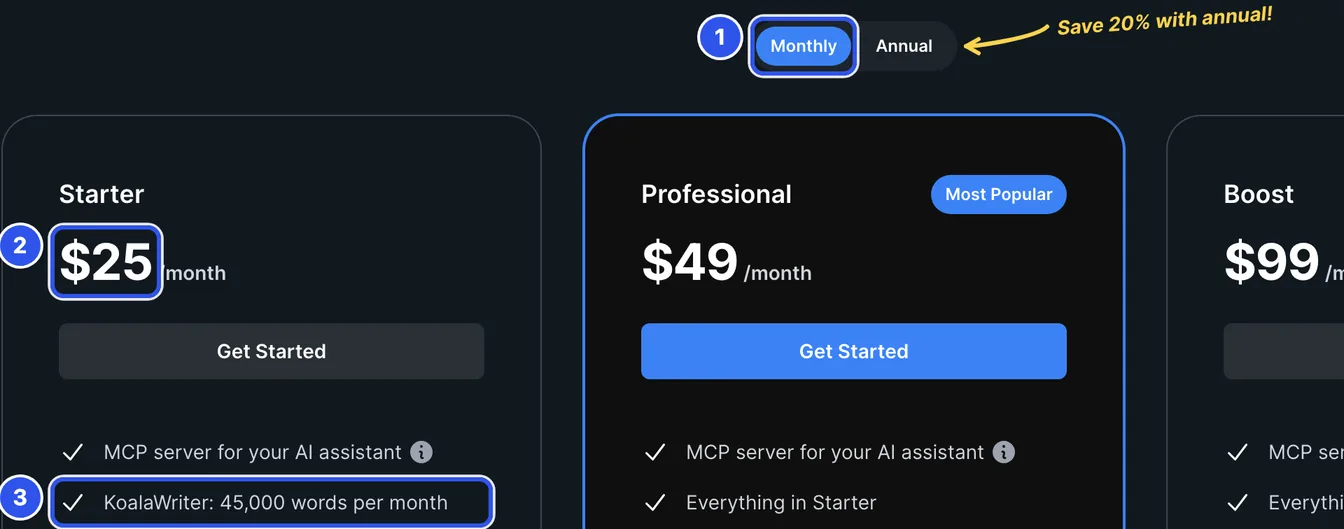
- Monthly billing is selected; annual saves 20%.
- Starter at $25 a month.
- The allowance is counted in words: 45,000 a month.
Koala counts words rather than articles. The 45,000 words on Starter assume its default GPT-6 Luna model; the pricing page notes that GPT-6.1 Sol and Claude Sonnet 5.5 count words at 2x and Claude Opus 5.5 at 3x, so choosing a stronger model halves or thirds the allowance. Starter already includes bulk writing, real-time factual data, live Amazon data for affiliate articles, and publishing to WordPress, Shopify, Webflow, Ghost and webhooks. Internal linking (KoalaLinks), the article editor with SEO score and a Search Console dashboard start with Professional at $49. A free allowance of 5,000 words needs no credit card.
Best for: affiliate publishers and bloggers who want one subscription with many CMS connections. Limit: the word allowance is easy to burn through on long articles with the better models.
3. Junia AI: autopilot blogging on a small budget
Junia AI's pricing page opens on yearly billing. Growth costs $17 a month and includes 10 SEO articles a month, auto keyword research, one-click internal and external linking, brand voice, AI images and all integrations (WordPress, Webflow and Shopify among them), in 150+ languages. Scale Starter at $29 a month raises that to 68 articles, generated and published on autopilot, with AutoBlog scheduling, bulk generation, a content planner and LLM brand visibility tracking.
Best for: small sites that want a scheduled blog without much setup. Limit: the low prices assume yearly billing, and autopilot publishing means nobody reads a draft unless you build that step in.
4. Frase: writer, optimizer and AI visibility in one plan
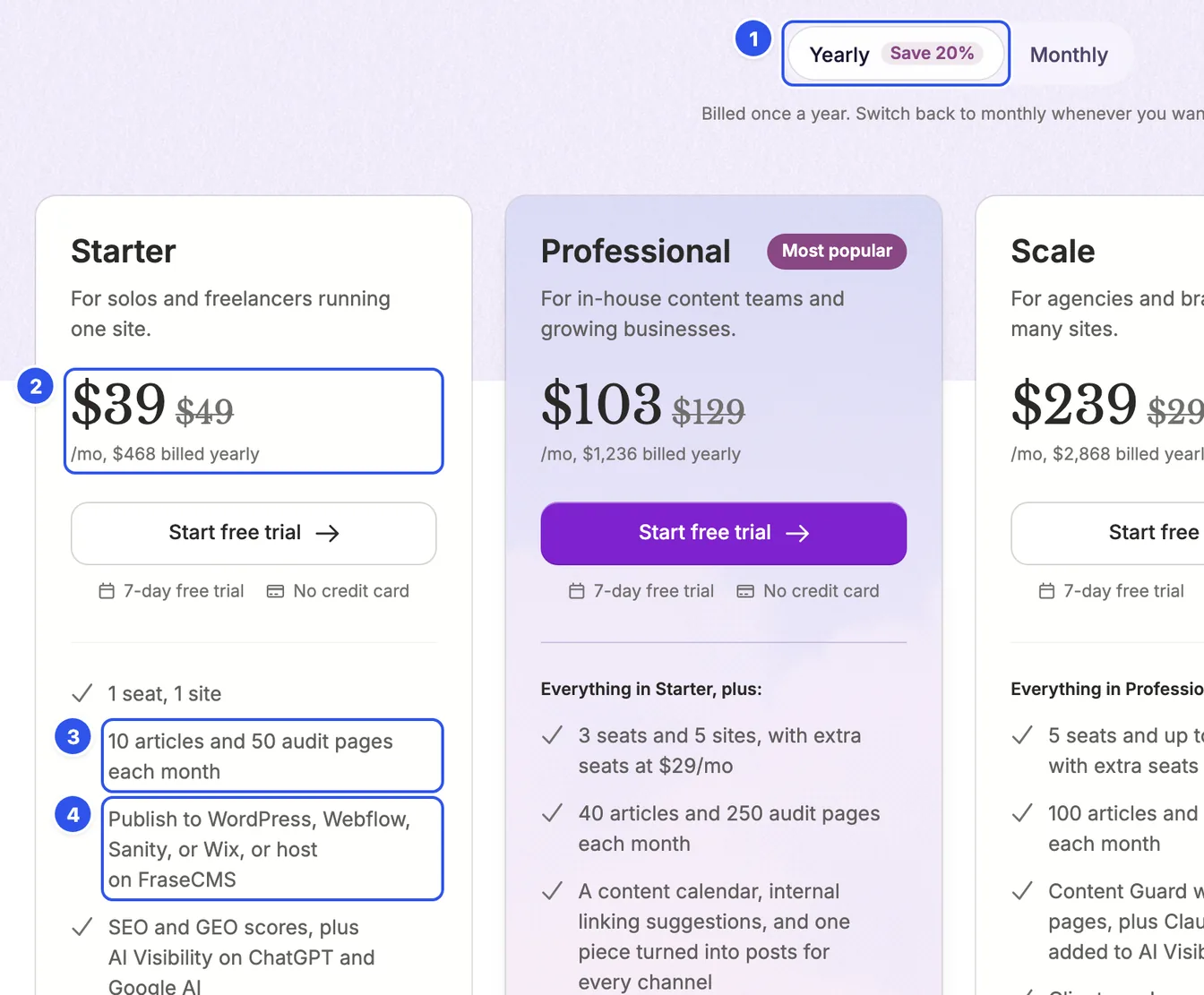
- Prices shown are for yearly billing (save 20%).
- Starter at $39 a month ($468 a year), against $49 billed monthly.
- 10 articles and 50 audit pages each month.
- Publishing to WordPress, Webflow, Sanity or Wix, or Frase's own hosted CMS.
Frase started as a brief and optimization tool and now runs the full loop: research, writing, images, publishing and monitoring. Starter includes SEO and GEO scores, AI visibility tracking on ChatGPT and Google AI, and "Content Guard," which watches 10 pages for ranking decay and proposes fixes. The agent can publish on its own if you switch that on. Professional ($103 a month yearly) adds a content calendar, internal linking suggestions and 40 articles. All plans come with a 7-day free trial and no credit card.
Best for: in-house marketers who want writing, scoring and a decay monitor in one place. Limit: 10 articles on Starter is few for the price, and internal linking suggestions start on Professional.
5. Citapult: research and sources first, then the draft
Citapult is our product, so here are the facts from its article agent page and where it fits.
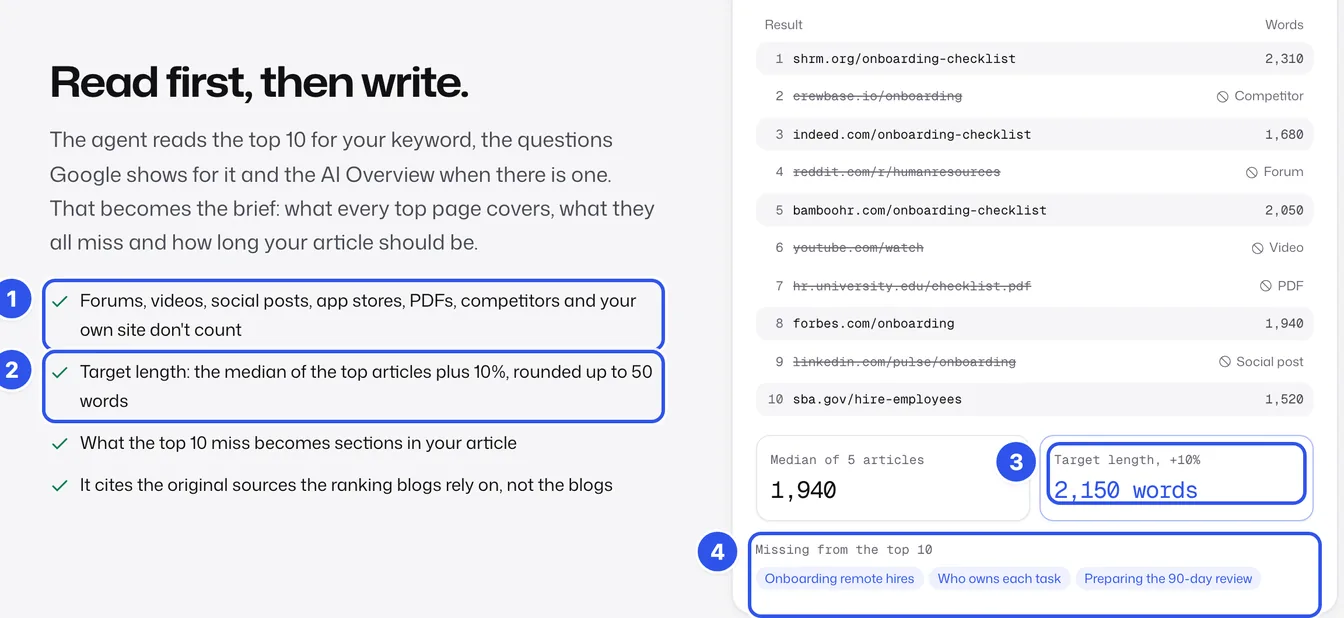
- Forums, videos, social posts, PDFs, competitors and your own site are dropped from the analysis.
- The target length is the median of the remaining top articles plus 10%, rounded up to 50 words.
- In this run: a median of 1,940 words became a 2,150-word target.
- Topics none of the top 10 covers become sections in your article.
Before it writes, the agent reads the top 10 results for your keyword, the questions Google shows for it and the AI Overview when there is one. It then asks you four expert questions about real numbers, common mistakes and how you do things, and your answers go into the text (you can skip any of them). Every number gets a source the agent fetched itself, citing the original source rather than the blogs that quote it. A check against 20+ fixed rules runs before you see the draft: keyword placement, at least 3 source domains, no links to competitors, no filler phrases. Images, internal links from your sitemap and publishing to WordPress, Webflow, Next.js or a webhook are part of every article.
Pro costs $99 a month per website (launch price, regular $199) for 30 articles, which works out to $3.30 an article; the pricing page has 60 and 90 article add-ons. A three-day Pro trial costs $1 and produces three real articles you keep. The examples page shows six unedited articles with 58 linked sources between them.
Best for: businesses that want fewer, sourced articles published on their own site, with someone checking the facts before they ship. Limit: no free plan and no Shopify, Wix or Ghost connection (the webhook covers custom setups). If you want 50+ articles a month for the lowest price, SEOWriting.ai or Junia are cheaper per article.
6. Surfer: the content score, now with AI visibility tracking
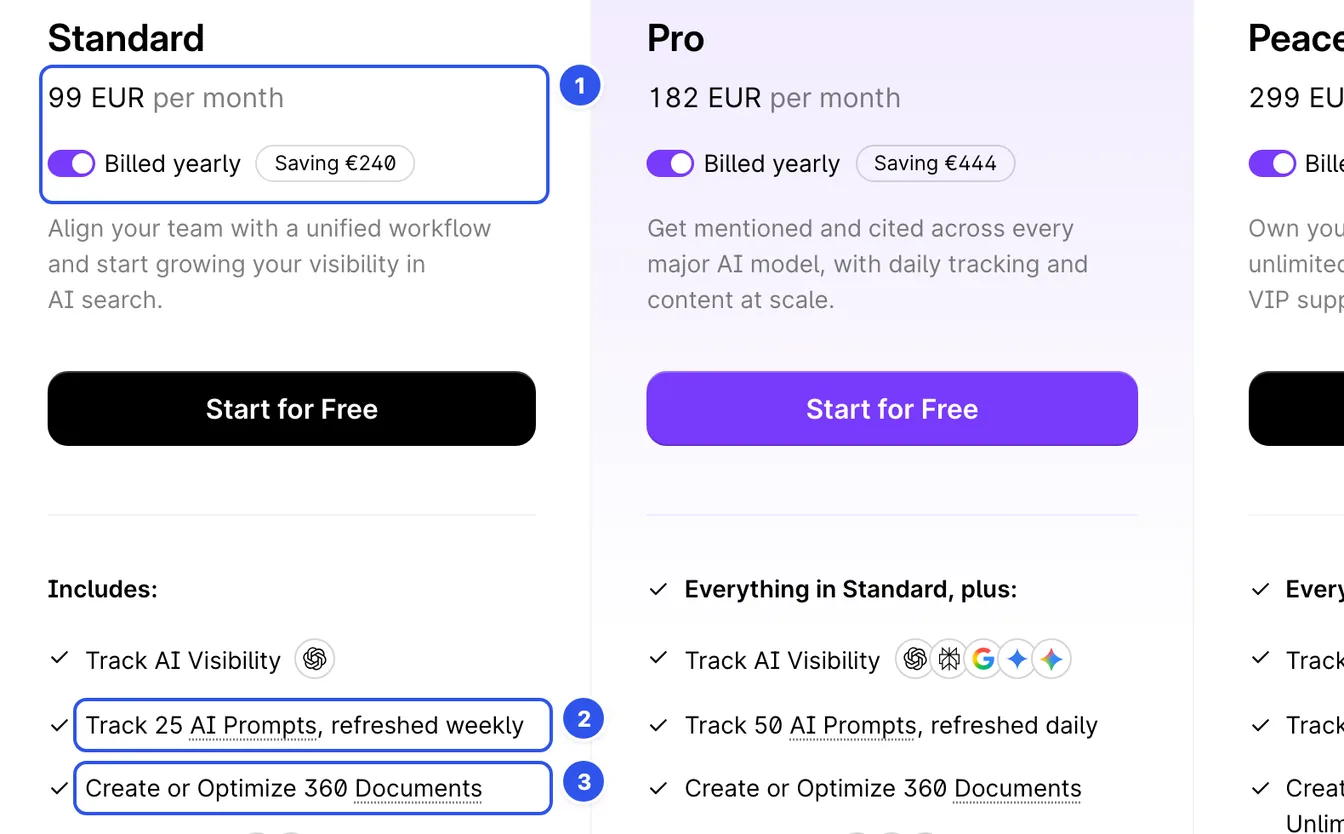
- Standard at 99 EUR a month, billed yearly.
- AI visibility tracking is now part of the plan: 25 prompts, refreshed weekly.
- 360 documents a year to create or optimize.
Surfer is best known for its content editor, which scores a draft against the pages that rank and suggests terms, headings and length. Its pricing page now leads with AI search visibility. The smallest plan, Discovery (€49 a month yearly), includes optimization guidelines, the Surfy AI assistant and a humanizer, and 120 documents. Standard adds integrations, plagiarism checks and rank drop detection; Pro (€182) adds one-click internal linking, templates and custom voices.
Best for: writers and editors who draft themselves (or with any AI) and want a clear score to optimize against. Limit: documents are counted per year, internal linking is a Pro feature, and the full-article writer is one part of a broader platform.
7. Semrush Content Toolkit: for teams already on Semrush
The Semrush Content Toolkit costs $60 a month after a 7-day free trial. It bundles Topic Finder, an SEO Brief Generator, the AI Article Generator with 5 SEO-boosted articles a month, a Content Optimizer and a Chrome extension. Extra articles cost $30 a month for 10 more. Articles can be written in American and British English, Spanish, French, Dutch, Italian, German and Portuguese, and you can publish through WordPress.
Best for: teams that already use Semrush for keyword data and want briefs and drafts from the same source. Limit: 5 articles a month is a small allowance; it is a research-and-brief tool more than a volume writer.
8. Jasper: brand voice for marketing teams
Jasper Pro costs $59 a month per seat billed yearly, or $69 billed monthly, with a 7-day free trial. Each seat gets 2 brand voices, 5 knowledge assets and 3 audiences, plus agents for core marketing workflows in 30+ languages. Business (custom pricing) adds agents for GEO and deep research, Jasper Grid for systematic content at scale and API access.
Best for: marketing teams that write across channels (ads, emails, landing pages) and need everything to sound on-brand. Limit: SEO is one use case among many; there is no built-in SERP analysis or CMS publishing on Pro.
9. Clearscope: optimization and drafts for editorial teams
Clearscope starts at $129 a month (Essentials) with a 14-day free trial, no contracts and unlimited users. Essentials includes 20 monthly drafts, 20 discoveries, 50 tracked queries and 50 pages; query tracking checks ChatGPT and Gemini for brand mentions and shows the web searches AI platforms run to build their answers.
Best for: content teams with human writers who want a trusted grading standard and AI search insight. Limit: the most expensive entry point here, and drafts are a supplement to the optimizer rather than a publishing pipeline.
10. ChatGPT and other general chatbots: flexible, but you supply the SEO
ChatGPT has a free plan, and our region showed Go at €8 and Plus at €23 a month on the pricing page. Plus adds deep research, projects, scheduled tasks and custom GPTs. With a good prompt, a keyword list and pasted research, a chatbot writes a solid draft, and several replies in the Reddit thread above say exactly that.
Best for: one-off articles, outlines and rewrites when you already know what the page needs. Limit: it does not see the current top 10 unless you browse or paste it, it does not check its own numbers, and it does not publish. Our explainer on AI SEO content writing covers the prompts and checks that close that gap.
Not on the list: Writesonic, a familiar name in this space, now sells itself as an AI search visibility platform. Its Starter plan ($79 a month billed annually) includes 15 AI articles next to prompt tracking, so it fits better in a list of free and paid AI SEO tools.
SEO writing tools compared
| Tool | Type | Entry price (as shown) | Output at entry | Free option | Publishes to |
|---|---|---|---|---|---|
| SEOWriting.ai | Article generator | $14/mo, billed yearly | Up to 50 articles | 3 articles, no card | WordPress, Shopify app |
| Koala AI | Article generator | $25/mo, billed monthly | 45,000 words | 5,000 words, no card | WordPress, Shopify, Webflow, Ghost, webhooks |
| Junia AI | Article generator | $17/mo, billed yearly | 10 articles | None listed | WordPress, Webflow, Shopify and more |
| Frase | Writer + optimizer | $39/mo, billed yearly | 10 articles | 7-day trial, no card | WordPress, Webflow, Sanity, Wix, FraseCMS |
| Citapult | Research agent | $99/mo per website | 30 articles | $1 for 3 days (3 articles) | WordPress, Webflow, Next.js, webhook |
| Surfer | Optimizer + writer | €49/mo, billed yearly | 120 documents | "Start for Free" sign-up | Via integrations |
| Semrush Content Toolkit | Marketing suite | $60/mo | 5 SEO-boosted articles | 7-day trial | WordPress |
| Jasper | Marketing suite | $59/seat/mo, billed yearly | Per seat | 7-day trial | None on Pro |
| Clearscope | Optimizer | $129/mo | 20 drafts | 14-day trial | None |
| ChatGPT | Chatbot | Free; Plus €23/mo | Chat-based | Free plan | None |
Prices from each vendor's pricing page on November 12, 2026. Yearly prices are per month; monthly billing costs more on every tool that offers both.
Which SEO writing tool should you pick?
- You run affiliate or niche sites and need volume: SEOWriting.ai or Koala AI. Budget time for editing, or the volume becomes a liability.
- You want a blog on autopilot for a small business: Junia AI is the cheapest scheduled option; Citapult costs more per article but researches each topic, asks for your expertise and sources every number before it publishes.
- You or your writers draft, and you want to optimize: Surfer or Clearscope for the score, Frase if you also want the draft and a decay monitor in one plan.
- You already pay for Semrush or run a marketing team: Semrush Content Toolkit for SEO briefs, Jasper for brand voice across channels.
- You publish a few articles a month and like to stay hands-on: ChatGPT or Claude with your own research is enough. Read our comparison of AI blog writers if you want more automation later.
How to get rankable articles out of any SEO AI writer
The tool matters less than the process around it. Before you publish an AI draft, check these points:
- Pick keywords you can win. A perfect article on a keyword dominated by big brands still sits on page three. Look at who ranks before you write.
- Brief from the results page. Note what every top page covers, what they all miss and how long they are. Most tools above do this; with a chatbot, do it yourself.
- Add what only you know. Google asks for "original information, reporting, research, or analysis." A number from your own data or a mistake you have seen customers make is what an AI cannot invent.
- Verify every fact. Click every source. AI tools still misquote numbers, and a wrong statistic costs more trust than a missing one.
- Put a real author on it. Google's guidelines encourage accurate bylines and warn against made-up names or AI-generated headshots.
- Link it into your site. New articles need internal links from and to related pages, or Google finds them late.
- Publish at a pace you can review. If nobody reads the drafts, you are generating "many pages without adding value," which is the scaled content abuse example above. More on finding a sustainable rhythm in our guide to automated blogging.
Before you pay for any tool, read output it produced without edits. Sales pages show the best case; unedited examples show what lands on your site.
FAQ
Can AI write SEO content?
Yes. Google says it rewards high-quality content however it is produced, and that using AI is not against its guidelines in itself. What it penalizes is generating many pages mainly to manipulate rankings without adding value for users. An AI draft that is researched, fact-checked and adds something the top results lack can rank like any other page.
Which AI is best for SEO writing?
It depends on the job. For volume on a budget, SEOWriting.ai and Koala AI write and publish the most articles per dollar. For optimizing your own drafts, Surfer, Frase and Clearscope grade them against the pages that rank. For sourced articles with research done before writing, Citapult reads the top 10 results and sources every number.
Is there a free SEO writer AI?
There are free entry points rather than free plans for regular use. SEOWriting.ai gives 3 free articles and Koala AI 5,000 free words, both without a credit card. Frase, Semrush, Jasper and Clearscope offer free trials of 7 to 14 days. ChatGPT's free plan can write drafts, but you supply the keyword research and checks yourself.
Can ChatGPT write SEO content?
It can write a good draft if you give it the keyword, the outline the results page suggests and your own facts. On its own it does not see the current top 10, does not check its numbers against sources and does not publish to your CMS. SEO writing tools add those steps around the same kind of model.
What does an SEO writer do?
An SEO writer researches what people search for, studies the pages that already rank and writes an article that answers the query better, with the keyword in the title and headings, clear structure, internal links and sources. SEO writer AI tools automate parts of that work, most often the research, the outline and the first draft.
Sources
- 1seowriting.aiSEOWriting.ai: pricing
- 2seowriting.aihomepage
- 3junia.aiJunia AI: pricing
- 4frase.ioFrase: pricing
- 5semrush.comSemrush: Content Toolkit
- 6jasper.aiJasper: pricing
- 7clearscope.ioClearscope: pricing
- 8chatgpt.comChatGPT: pricing
- 9writesonic.comWritesonic: pricing
- 10developers.google.comGoogle Search Central Blog: Google Search's guidance about AI-generated content
- 11developers.google.comGoogle Search Essentials: spam policies
- 12developers.google.comGoogle Search Central: creating helpful, reliable, people-first content
- 13reddit.comReddit r/seogrowth: What are the best AI Tools for Writing better SEO Content?