Automated Blogging: What It Is, How It Works and What Google Allows
Automated blogging explained: the four kinds with real examples, what Google's spam policies allow, what 600,000 pages say about AI content, and a safe setup.

Automated blogging means using software to handle some or all of the work of running a blog: picking topics, drafting posts, adding images, publishing on a schedule and notifying people. It ranges from a few Zapier steps that move a human-written draft along to AI pipelines that write and publish ten posts a day without anyone reading them. Google does not ban automated or AI-written posts, but it treats pages generated at scale "without adding value for users" as spam. The useful question is not whether to automate blogging, but which steps to automate and where a person still has to look.
TL;DR
- Automated blogging comes in four kinds: workflow automation around human writing, DIY AI pipelines (n8n, Zapier), RSS autoblogging that rewrites other sites' feeds, and AI blog agents that research, write and publish.
- Google's spam policy on scaled content abuse targets pages made "for the primary purpose of manipulating search rankings and not helping users", no matter how they are made. AI itself is not the problem.
- In an Ahrefs study of 600,000 ranking pages, 86.5% contained some AI-generated content, and the correlation between AI share and ranking was 0.011, effectively zero.
- Automate research, drafting, formatting, images and scheduling. Keep a human on facts, first-hand experience and the final yes.
- Feed-scraping autoblogs are the one kind Google names almost word for word as spam. Skip them.
What is automated blogging?
Automated blogging (also called autoblogging or blog automation) is any setup where software, not a person, does recurring blog work. That can be one step, such as publishing a finished post at 6 a.m., or the whole chain from keyword to live URL. An "auto blogger" or "blog bot" usually refers to the second kind: a tool that writes and posts on its own.
Automation itself is old. Google pointed out in 2023 that "automation has long been used to generate helpful content, such as sports scores, weather forecasts, and transcripts." What changed is that language models can now write the article too, so the cost of a post dropped from hours to cents. That is why "automated blogging" now mostly means AI writing plus automatic publishing, and why Google's rules matter more than they used to.
The four kinds differ in what gets automated and how much risk they carry:
| Kind | What software does | What a person does | Search risk |
|---|---|---|---|
| Workflow automation | Moves drafts between tools, notifies editors, uploads | Writes, edits, approves | Very low |
| DIY AI pipeline (n8n, Zapier + an LLM) | Picks topics, writes, adds images, publishes | Builds and maintains the workflow | Depends on the prompts and on review |
| RSS autoblogging | Pulls other sites' feeds, rewrites, republishes | Nothing after setup | High: Google lists it as scraping |
| AI blog agent | Researches, writes, adds images and links, schedules, publishes | Sets the plan, adds experience, reviews | Low with review, higher without |
The four kinds of automated blogging, with real examples
1. Workflow automation: a human writes, software does the rest
Anna Burgess Yang, who writes the blog Tinkering With Ideas, automated everything around her writing so that an editor and a virtual assistant can take over the publishing work. She dictates a post into Cleft and adds a tag. Zapier then creates a Google Doc with the transcript, adds a Trello card in a "Dictated" column and emails her editor. When the editor moves the card to "Ready to Upload", a Trello automation hands it to her virtual assistant, who loads the edited post onto her Ghost site. In her words: "I only need to dictate a blog post and add a tag."
Nothing in that chain writes for her. It is the safest kind of automated blogging, because every word is still hers, and it removes exactly the steps that make solo bloggers stop posting: file handling, reminders and uploading.
2. DIY AI pipelines: n8n and Zapier workflows that write and post
The top Google result for "n8n blog automation" is a free n8n template by Jay Emp0 called "Content farming", subtitled "AI-powered blog automation for WordPress". It is a good look at what a full DIY pipeline does, and at its limits.
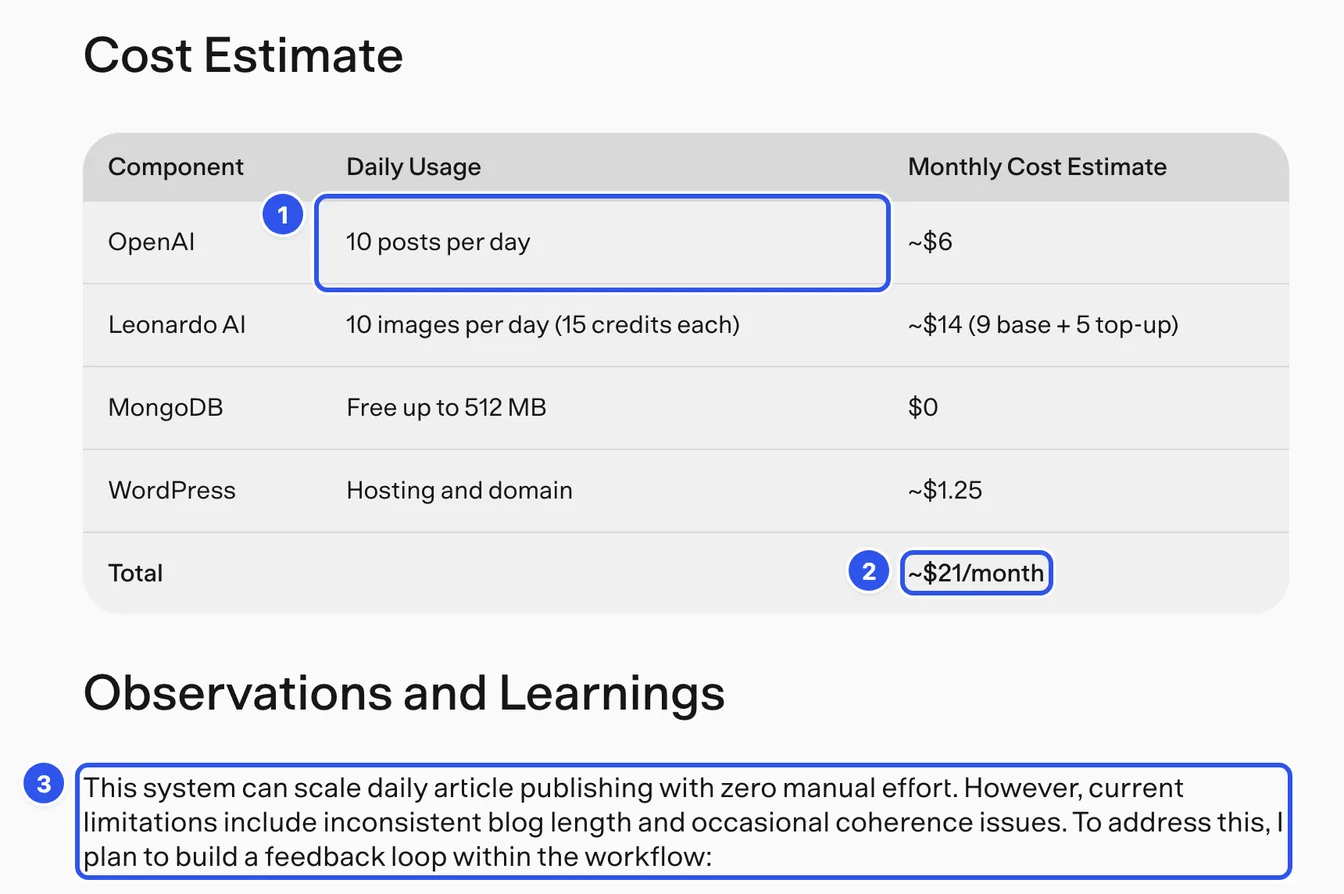
- The workflow publishes 10 posts per day. A scheduler pulls news from RSS feeds (BBC, TechCrunch, Wired, MIT Tech Review, HackerNoon and others), an OpenAI classifier keeps the relevant items, and GPT-4o-mini writes a 1,000 to 1,500 word article from each.
- The whole stack, including AI images from Leonardo AI and WordPress hosting, costs about $21 a month.
- The author's own verdict: it runs "with zero manual effort", but has "inconsistent blog length and occasional coherence issues." The planned fix is two more AI agents that review the drafts.
The template's author is open about the trade-off, which makes it a useful example. Cheap, unattended volume is easy to build now. Quality control is the part that does not come with it, and the template starts from other sites' news, which brings it close to what Google calls scaling content from feeds (see below). Another popular template, "Automate blog content creation with GPT-4, Perplexity & WordPress", writes a short article of at most 20 lines from a topic you enter in a form, posts it and sends Slack and Gmail notices.
DIY pipelines suit people who like building workflows and want full control over prompts and costs. You also own the maintenance: API keys, broken nodes and the quality checks the template does not have.
3. RSS autoblogging: rewriting other people's feeds
The oldest form of autoblogging takes RSS feeds from other sites and republishes the posts, often run through a synonym spinner or now an LLM so they look new. Google's spam policies describe this almost word for word. Under "Scraping", they list "republishing content from other sites without adding any original content or value, or even citing the original source" and "reproducing content feeds from other sites without providing some type of unique benefit to the user." Under scaled content abuse, they add "scraping feeds, search results, or other content to generate many pages (including through automated transformations like synonymizing, translating, or other obfuscation techniques)."
If a setup's main input is somebody else's articles, it is in the riskiest category no matter how good the rewriting is.
4. AI blog agents: research, write and publish as one job
The newest kind treats the blog as one connected job instead of a chain of tools: find keywords, research what already ranks, write, add images and internal links, then publish on a calendar. The difference from a DIY pipeline is mostly in the research and the checks before anything goes live.
Citapult works this way. Its article agent reads the top 10 Google results for each keyword, plus the questions Google shows and the AI Overview when there is one, and turns that into a brief. It asks you 4 questions about real numbers, common mistakes and how you work, so the post contains experience no other page has, and it checks every draft against 20+ fixed rules before you see it. You can read six unedited example articles to judge the output yourself. For a wider comparison of writing tools, see our guide to AI blog writers and the explainer on what an SEO AI agent does.
What Google says about automated blogging
A handful of Google pages settle most of the debate, and they agree on one point: Google judges what a page does for the reader, not whether a person or a model wrote it.
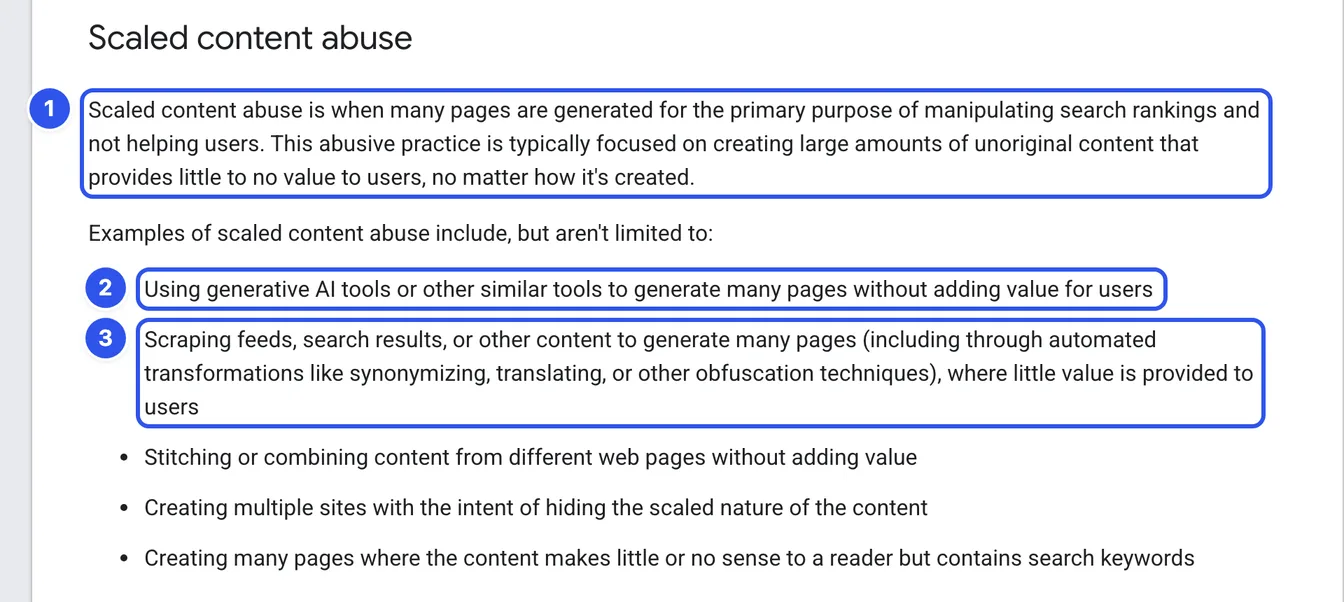
- The definition: many pages "generated for the primary purpose of manipulating search rankings and not helping users", "no matter how it's created." Human content farms count too.
- The first example names generative AI directly, but only "without adding value for users."
- The second example covers feed scraping and automated rewriting, the classic RSS autoblog.
Google introduced this policy on March 5, 2024, together with two others (expired domain abuse and site reputation abuse). The announcement says it lets Google act "no matter whether content is produced through automation, human efforts, or some combination of human and automated processes." The policy is not about AI. It is about scale without value.
Google's February 2023 post on AI content says the same from the other side: using automation "with the primary purpose of manipulating ranking in search results is a violation of our spam policies", but "not all use of automation, including AI generation, is spam."
The third page is the most practical one for anyone who wants to automate blogging, because it says what to do:
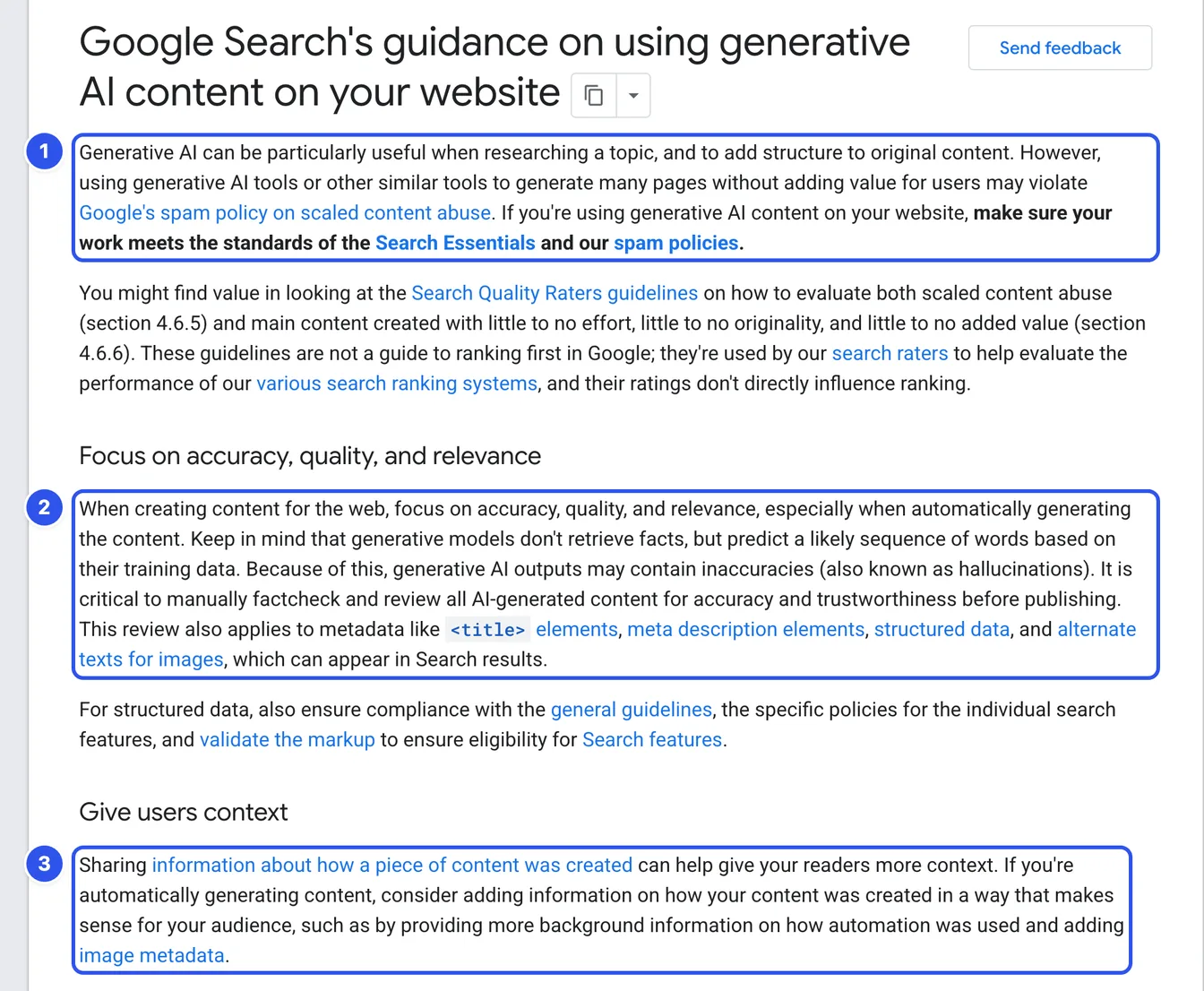
- Generative AI is "particularly useful when researching a topic, and to add structure to original content", while mass pages without added value may violate the scaled content abuse policy.
- Models "don't retrieve facts, but predict a likely sequence of words", so Google calls it "critical to manually factcheck and review all AI-generated content" before publishing, including titles, meta descriptions, structured data and alt text.
- If you generate content automatically, Google suggests telling readers how automation was used.
Point ② is the one most automated blogs skip, and it is the reason an unattended pipeline is risky even when the writing reads well: a model fills gaps with plausible numbers.
Does AI-written content rank?
The best public data comes from Ahrefs. In July 2025, Si Quan Ong published an analysis of 600,000 pages: the top 20 results for 100,000 random keywords, each run through Ahrefs' AI content detector.
| Finding (Ahrefs, 600,000 pages) | Value |
|---|---|
| Pages classified as pure AI | 4.6% |
| Pages classified as pure human | 13.5% |
| Pages mixing human and AI writing | 81.9% |
| Top-ranking pages with some AI content | 86.5% |
| Correlation between AI share and ranking position | 0.011 |
| Marketers using AI to create content (separate Ahrefs survey of 879) | 87% |
Two takeaways. First, Google neither rewards nor punishes AI writing as such: a correlation of 0.011 is "effectively zero", in Ahrefs' words. Second, pure AI pages are rare at the top, and the #1 results "tend to have slightly less AI-generated content." Ahrefs calls that correlation very weak, but it matches Google's guidance: the pages that win usually have something a model alone could not add, such as first-hand experience, original data or a careful edit. Our explainer on AI SEO content writing goes deeper into what that looks like in a draft.
What to automate and what to keep human
Read together, Google's guidance and the data point to a simple split. Automate the steps where software is faster and as accurate as a person. Keep a person where accuracy, experience or judgment decides whether the post helps anyone.
| Step | Automate? | Why |
|---|---|---|
| Keyword and topic research | Yes | Search data is structured, and tools read it faster than people |
| Reading what already ranks | Yes | An agent can read the top 10 for every keyword; people rarely do |
| First draft and structure | Yes | Google itself calls AI useful "to add structure" |
| Images, alt text, meta data | Yes, then check | Google asks you to review titles, meta descriptions and alt text too |
| Facts, numbers and quotes | Check by hand or against fetched sources | Models predict words; they do not retrieve facts |
| First-hand experience | No | Only you know your numbers, mistakes and methods |
| Final approval | No, at least at first | One bad post at scale becomes a hundred bad posts |
| Scheduling and publishing | Yes | No judgment needed once a post is approved |
| Social posts and notifications | Yes | Pure logistics, as in Anna Burgess Yang's setup |
How to set up automated blogging without risking a penalty
- Pick a cadence you can review. If you cannot read every post at the start, publish fewer. Volume is the part that turns into scaled content abuse.
- Start from keywords and your own expertise, not from other sites' feeds. A pipeline whose input is someone else's articles is close to scraping by Google's definition.
- Ground the draft in sources. Have the tool read what ranks and link the original sources it used, so every number can be checked against a page, not against the model's memory.
- Add one thing only you know. A number from your business, a mistake you made, a method you use. This is what pure AI pages lack, and what Google's guidance on helpful content asks for: content that shows "first-hand expertise and a depth of knowledge."
- Review before the post goes live, then automate publishing. Keep a "needs review" step until you trust the output, then let a scheduler handle the rest.
- Say how the post was made where it makes sense for your readers, as Google suggests.
- Watch rankings and fix posts that slip. Automated blogging is not "set and forget". Posts that drop need updates. Citapult connects to Google Search Console and revises articles that slip in rankings.
Step 5 is where automation pays off without taking control away from you. In Citapult, each article gets a calendar day and waits as "Needs review" until you approve it. Turn on "Publish automatically", and on its day it goes to WordPress, Webflow, Next.js or a webhook within 15 minutes of your set time.
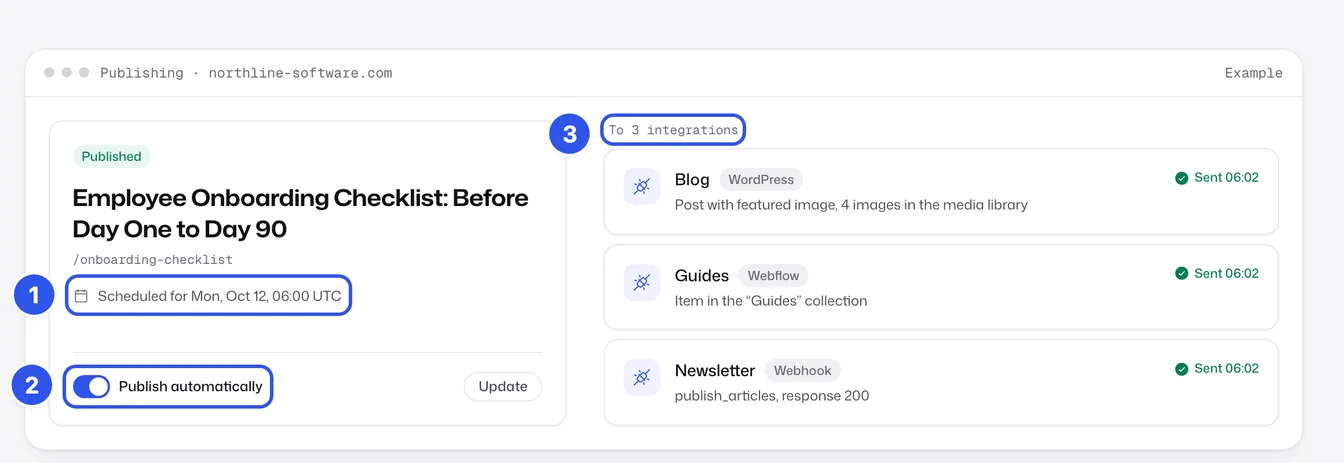
- Every article has a date and time on the calendar.
- "Publish automatically" is a switch you turn on yourself. Until you do, the article waits as "Needs review".
- One article can go to several destinations at once, here a WordPress blog, a Webflow collection and a webhook. Details on automatic publishing.
For the bigger picture of which SEO tasks are worth automating beyond the blog, read our guide to SEO automation.
Common mistakes with automated blogs
- Publishing every draft unread. The n8n template's author lists "occasional coherence issues" after running his own pipeline. You will find similar issues in yours, but only if you read the posts.
- Using other sites' news or feeds as raw material. It is cheap, and it is the one input Google names as spam.
- Letting the model invent numbers. Google warns that generative AI output "may contain inaccuracies (also known as hallucinations)." A post with a wrong statistic does more harm than no post.
- Chasing volume over usefulness. Ten posts a day is easy to set up. Whether anyone needs ten posts a day on your topic is a different question.
- Forgetting the metadata. Google's review advice covers titles, meta descriptions, structured data and alt text, not only the body text.
- No owner. Automated blogs fail quietly: a broken API key or an expired credential stops publishing for weeks. Someone has to check that posts still go out.
FAQ
What is autoblogging AI?
Autoblogging AI is software that writes and publishes blog posts with a language model, usually on a schedule. Some tools only draft text; others also research keywords, add images and internal links and publish to WordPress or another CMS. The term also covers DIY workflows in n8n or Zapier that connect an AI model to a blog.
Is autoblogging legal?
Writing your own posts with AI and publishing them automatically is common practice, and Google does not ban it. Republishing other sites' articles from their RSS feeds is different: whether that infringes copyright is a question for a lawyer, but for search it is settled, because Google lists it under scraping and scaled content abuse. When in doubt, use your own topics and cite sources instead of copying them.
Does Google penalize automated blogs?
Not for being automated. Google's policies target pages "generated for the primary purpose of manipulating search rankings and not helping users", whether they come from AI, people or both. Automated blogs get into trouble when they publish many low-value pages, rewrite other sites' content or spread unchecked facts.
Do AI blogs make money?
They can, the same way any blog does: through traffic that turns into ad revenue, affiliate sales or customers. AI changes the cost of a post, not how readers or Google judge it. Ahrefs found AI content in 86.5% of top-ranking pages, so AI-written posts can earn traffic, but pure AI pages are rare at the very top.
What are the best tools for autoblogging?
It depends on how much you want to build. Zapier and Trello handle workflow automation around human writing. n8n has free templates for full AI pipelines if you are willing to maintain them. AI blog agents like Citapult combine keyword research, writing, images and scheduled publishing in one tool. Our roundup of AI blog writers compares the options.
Sources
- 1developers.google.comSpam Policies for Google Web Search
- 2developers.google.comGoogle Search's guidance on using generative AI content on your website
- 3developers.google.comGoogle Search's guidance about AI-generated content
- 4developers.google.comWhat web creators should know about our March 2024 core update and new spam policies
- 5developers.google.comCreating helpful, reliable, people-first content
- 6ahrefs.comAI-Generated Content Does Not Hurt Your Google Rankings (600,000 Pages Analyzed)
- 7n8n.ioContent farming: AI-powered blog automation for WordPress
- 8n8n.ioAutomate blog content creation with GPT-4, Perplexity & WordPress
- 9tinkeringwithideas.ioHow to Automate Your Blog Publishing Process